
Chamise Adenostoma fasciculatum
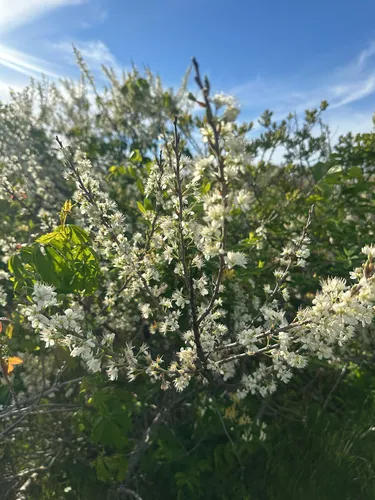
Chamise is a perennial shrub native to the lower 48 states. It grows to 10 ft and blooms Apr in part shade – shade, with brown fruit.
More about this plant
Adenostoma fasciculatum, commonly known as chamise or greasewood, is a flowering plant native to California and Baja California. This shrub is one of the most widespread plants of the California chaparral ecoregion. Chamise produces a specialized lignotuber underground and at the base of the stem, known as a burl, that allow it to resprout after fire has off burned its stems. It is noted for its greasy, resinous foliage, and its status as one of California's most iconic chaparral shrubs. Wikipedia →
Growing & care
USDA PLANTS · TRY- Sun
- Part shade – shade
- Soil & moisture
- Medium moisture
- Soil pH
- 4–6
- Fertility need
- Low
- Adapts to
- Coarse (sandy), Medium (loam), Fine (clay)
- Hardiness
- USDA zone 11+
- Height
- 10 ft
- Spacing
- 5–6 ft apart from USDA planting density
- Growth form
- Thicket-forming
- Lifespan
- Perennial · moderate
- Foliage
- Evergreen broadleaf · medium texture
- Active growth
- Autumn through spring
- Fruit
- Brown persists into winter
- Flower colour
- White AI AI image-analysis of community-science photos (~87% expert agreement) — not a botanical record
- Propagate by
- Seed, Bare root, Container
- Seed starting
- No stratification needed
- Seeds ripen
- Summer – Autumn seed-collection / harvest window
- In the trade
- Contract growing only
- Deer browsing
- Medium moderately palatable
- Resprouts if cut
- Yes regrows after top-kill
Sow timing keys off your local last- and first-frost dates.
Wildlife & pollinators
How pollinator value is scored →❧ Caterpillar hosts Documented caterpillar host
Recorded feeding on Adenostoma in North America, including:


+ 8 more species → ↑ show fewer


✦ Bees 21 bee visitors
21 native & managed bee species are documented visiting Chamise — the 12 most-recorded:


Wildlife & visitors 1 bird · 15 nectaring
Open records of who else uses Chamise — a generalist food-web signal, kept separate from the keystone Ecological Value.
Recorded eaten by 1 bird species (fruit, seed, browse):

15 adult butterfly & moth species are recorded nectaring at its flowers — the most-recorded:


Related plants
More Adenostoma →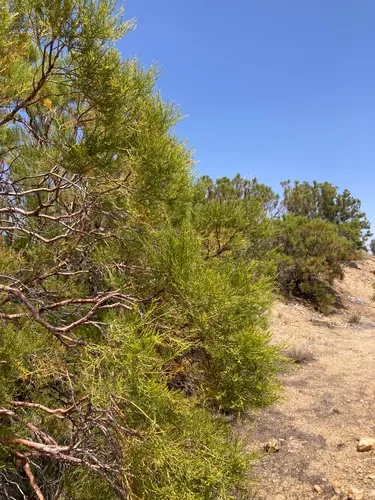
How we know this (4) Methods & honest limits
We read each species’ measured specific leaf area (leaf area per unit dry weight) from the Global Spectrum dataset and band it: thin & fast (high SLA), medium, or thick & tough (low SLA). The global median is about 10 mm²/mg.
Honest limits: A species-mean from pooled measurements — individual plants vary with light and site. A broad strategy signal, not a precise per-plant figure.
A recorded categorical fact: each species is tagged C3 (standard), C4 (heat/water-efficient) or CAM (succulent, night-time CO₂ uptake) — or a facultative combination. We only show a trait card for the noteworthy C4/CAM cases; C3 is the unremarkable majority, kept in the data but not surfaced as a card.
We take the plant’s U.S. county range and look up each county’s long-term climate, then summarise: native rainfall = the median annual rainfall across its counties; heat tolerance = the warm end (90th percentile) of average temperature across its range (mirroring how our cold-hardiness floor uses an extreme). Counties + medians blunt the roadside/observer bias that makes point-level climate unreliable. Needs at least five placeable counties.
Honest limits: A realized, sampling-biased niche (where it has been recorded, not its physiological optimum), and county climate is coarse — large Western counties span deserts and mountains. Derived guide, never a measured fact.
McKenzie et al. assigned each species a flower colour with a GPT-4V vision model over iNaturalist photos. We use the confident tier plus a separately-labelled lower-confidence top-up (mostly inconspicuous green/brown flowers), and render it as a small tint — never as an asserted fact, and kept out of the written synopsis.
Honest limits: AI image inference (~87% expert agreement on the confident tier); a decorative, confidence-tiered indicator, not a measured trait.
Sources for this entry (34) Open & cited
Cite this page Open data, please attribute
PlantKey’s data is open under CC BY-SA 4.0 — free to reuse and adapt, with attribution and the same licence. Photos keep their own per-image licence + credit (see Sources above).
Loading…
BibTeX
Loading…