PlantKey Open ecological atlas
Planner
Home / Browse / Arabis / Silver Rockcress
No openly-licensed photo yetWe add Creative-Commons photos from iNaturalist as they’re published.
Brassicaceae family

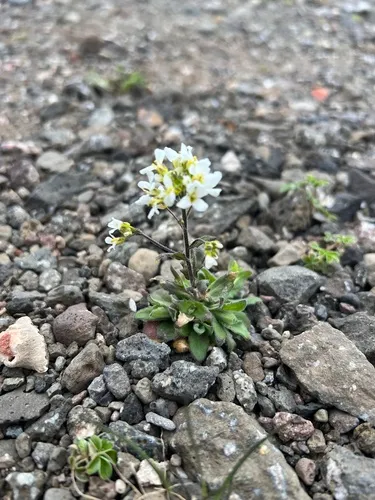
Silver Rockcress Arabis puberula

Native Specialist-bee host

Silver Rockcress is a biennial wildflower native to the lower 48 states. It blooms Apr – Aug. A host for pollen-specialist native bees.

Growing & care

USDA PLANTS · TRY
Conditions
Sources · Conditions
Cold hardiness (derived) — Hardiness
Hardiness
≥ zone 7 derived from its U.S. range
Size & form
Sources · Size & form
USDA PLANTS — Lifespan
TRY Plant Trait Database (CC BY 4.0) — Foliage
Lifespan
Biennial
Foliage
Broadleaf
In the garden
Herb layer — Sits in the herb of a layered food forest or polyculture.Open guide →
derived roles
The garden year bloom → fruit → fall colour
J
F
M
A
M
J
J
A
S
O
N
D
Bloom
Bloom (the flower's colour)
Bloom · Apr – Aug — 49 obs · Herbarium specimens — Park et al. 2023 (CC BY 4.0)
Species characteristics from USDA PLANTS (public domain) + TRY (CC BY) — general guidance, not a guarantee for your exact site. Deer "browsing" is documented palatability, not a deer-proof claim.

Wildlife & pollinators

How pollinator value is scored →
❧ Caterpillar hosts ~7 caterpillar species

Arabis supports ~7 caterpillar species.

Native butterfly & moth caterpillars are the base of the terrestrial food web — most songbirds rear their young almost entirely on them. As a host for native Lepidoptera this is a modest genus.

Keystone count (genus-level) from Warren II 2026 (CC0) · Tallamy host-use records. Named species (a documented Nearctic sample, not exhaustive) from NHM HOSTS (CC0).
✦ Bees specialist-bee host

Specialist native bees depend on it.

Some native bees are pollen specialists (oligolectic) — they raise young only on pollen from particular plant genera. Arabis is a recorded specialist-bee host, so losing it can mean losing the bee that relies on it.

Specialist hosts from Smith et al. 2024.
Species thumbnails re-hosted from iNaturalist — Creative Commons, credited per image (hover for credit). Click any species to see it on iNaturalist. Not exhaustive; many taxa have no openly-licensed photo yet.
Sources for this entry (11) Open & cited
[01] Scientific name & family — USDA PLANTS (DwCA, Zenodo 17903503)
[02] Growth habit & duration — USDA PLANTS (DwCA, Zenodo 17903503)
[03] Native status & distribution — USDA PLANTS (DwCA, Zenodo 17903503)
[04] Common name — USDA PLANTS (via GBIF)
[05] Invasive / introduced status — USDA PLANTS (DwCA, Zenodo 17903503) — native status
[06] Ecological value — Warren II 2026 (CC0) · Tallamy host-use counts · Smith et al. 2024 (CC BY)
[09] Cold hardiness (derived) — Derived from U.S. range × USDA PHZM zones
[10] Caterpillar host count — Warren II 2026 (Dryad, CC0) · Tallamy host-use counts
[11] Caterpillar species — NHM HOSTS (CC0)
Spot an error or have a better photo? Every field links to its source, and the whole dataset is open.
Cite this page Open data, please attribute

PlantKey’s data is open under CC BY-SA 4.0 — free to reuse and adapt, with attribution and the same licence. Photos keep their own per-image licence + credit (see Sources above).

Citation

Loading…

BibTeX
Loading…