PlantKey Open ecological atlas
Planner
Home / Browse / Argyroxiphium / Hawai'i Silversword
Wikimedia Commons — CC, credited & licensed per image
Asteraceae family

Hawai'i Silversword Argyroxiphium sandwicense

Native
Also known as: East Maui Silversword · Haleakala Silversword · Mauna Kea Silversword · Silversword

Hawai'i Silversword is a perennial shrub native to Hawaii.

More about this plant

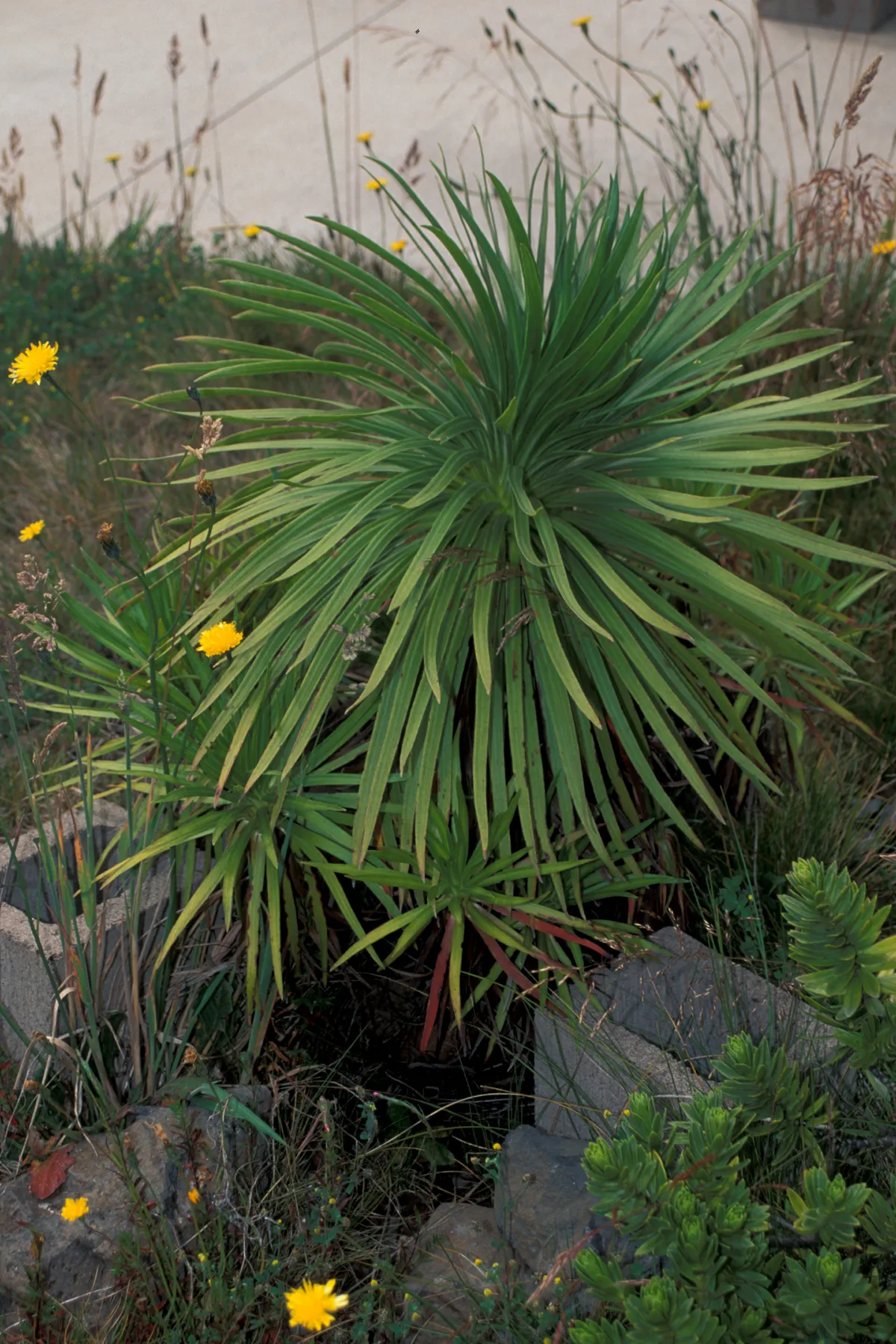
Argyroxiphium sandwicense, the Hawaiʻi silversword, or hinahina is a species of silversword. It is endemic to Hawaii. The two subspecies are separated by geography. Both subspecies are rare, threatened and federally protected.Haleakala silversword is found on the mountain Haleakalā on the island of Maui at elevations above 2,100 m (6,900 ft). It is a federally listed threatened species. Mauna Kea silversword is found on the mountain Mauna Kea on the Hawaii Island at elevations above 2,600 m (8,500 ft). It is a federally listed endangered species. As few as 40 individuals are left. Wikipedia →

Growing & care

USDA PLANTS · TRY
Size & form
Sources · Size & form
USDA PLANTS — Lifespan
Lifespan
Perennial
In the garden
Shrub layer — Sits in the shrub of a layered food forest or polyculture.Open guide →
derived roles
Species characteristics from USDA PLANTS (public domain) + TRY (CC BY) — general guidance, not a guarantee for your exact site. Deer "browsing" is documented palatability, not a deer-proof claim.

Wildlife & pollinators

How pollinator value is scored →
✦ Bees 2 bee visitors

2 native & managed bee species are documented visiting Hawai'i Silversword :

Visitor records (observations, not exhaustive) from Noori et al. 2026 (CC BY 4.0) · GloBI →
Species thumbnails re-hosted from iNaturalist — Creative Commons, credited per image (hover for credit). Click any species to see it on iNaturalist. Not exhaustive; many taxa have no openly-licensed photo yet.
How we know this (1) Methods & honest limits
Leaf build Direct fact

We read each species’ measured specific leaf area (leaf area per unit dry weight) from the Global Spectrum dataset and band it: thin & fast (high SLA), medium, or thick & tough (low SLA). The global median is about 10 mm²/mg.

Honest limits: A species-mean from pooled measurements — individual plants vary with light and site. A broad strategy signal, not a precise per-plant figure.

Díaz, S. et al. (2022) The global spectrum of plant form and function: enhanced species-level trait dataset. Scientific Data 9:755.
Derived values are computed from open data by a published method — labelled, cited, and never shown as a direct observation. Full methodology →
Sources for this entry (14) Open & cited
[01] Scientific name & family — USDA PLANTS (DwCA, Zenodo 17903503)
[02] Growth habit & duration — USDA PLANTS (DwCA, Zenodo 17903503)
[03] Native status & distribution — USDA PLANTS (DwCA, Zenodo 17903503)
[04] Common name — USDA PLANTS (via GBIF)
[05] Invasive / introduced status — USDA PLANTS (DwCA, Zenodo 17903503) — native status
[07] Description — Wikipedia (CC BY-SA)
[08] Ecological value — GloBI
[09] Conservation rank — NatureServe Explorer (CC BY)
[10] Functional traits — TRY Plant Trait Database (CC BY 4.0)
[11] Other common names — Wikidata (CC0)
[13] Flower-visitor value (derived) — Noori et al. 2026 (CC BY 4.0) · GloBI
[14] County range — GBIF Open Data — open-licensed occurrences (CC0/CC-BY) → county
Spot an error or have a better photo? Every field links to its source, and the whole dataset is open.
Cite this page Open data, please attribute

PlantKey’s data is open under CC BY-SA 4.0 — free to reuse and adapt, with attribution and the same licence. Photos keep their own per-image licence + credit (see Sources above).

Citation

Loading…

BibTeX
Loading…