PlantKey Open ecological atlas
Planner
Home / Browse / Asimina / Dwarf Pawpaw
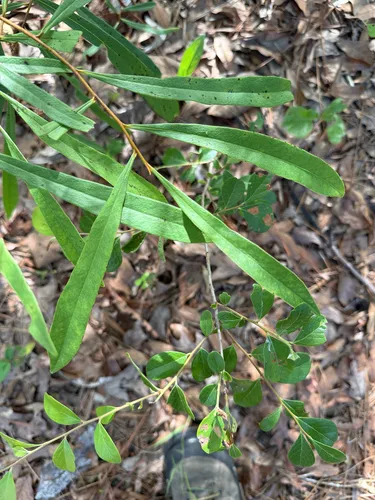
No openly-licensed photo yetWe add Creative-Commons photos from iNaturalist as they’re published.
Annonaceae family

Dwarf Pawpaw Asimina pygmea

Native

Dwarf Pawpaw is a perennial shrub native to the lower 48 states. It blooms Apr – Jun.

More about this plant

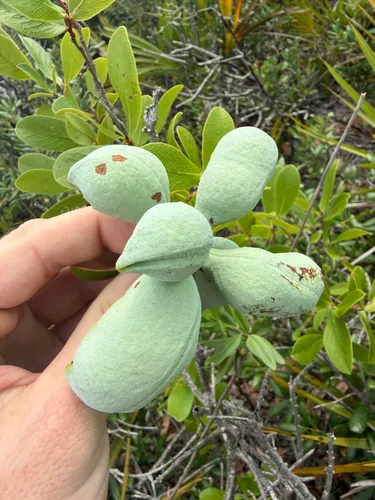
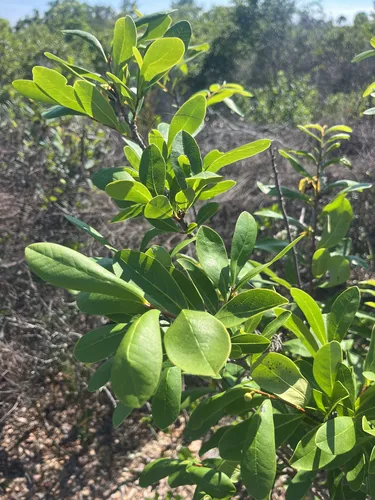
Asimina pygmaea, the dwarf pawpaw or gopher berry, is a species of plant in the family Annonaceae. It is native to Florida and Georgia in the United States. William Bartram, the American naturalist who first formally described the species using the basionym Annona pygmaea, named it after its dwarfed stature. Wikipedia →

Growing & care

USDA PLANTS · TRY
Conditions
Sources · Conditions
Cold hardiness (derived) — Hardiness
Hardiness
≥ zone 9 derived from its U.S. range
Size & form
Sources · Size & form
USDA PLANTS — Lifespan
McKenzie et al. 2025 — community-science image analysis (MIT) — Flower colour
Lifespan
Perennial
Flower colour
Pink AI AI image-analysis of community-science photos (~87% expert agreement) — not a botanical record
In the garden
Shrub layer — Sits in the shrub of a layered food forest or polyculture.Open guide →
derived roles
AI = read by an AI vision model · DERIVED = a computed estimate, not a direct measurement. The “How we know this” section below details each.
The garden year bloom → fruit → fall colour
J
F
M
A
M
J
J
A
S
O
N
D
Bloom
Bloom (the flower's colour)
Bloom · Apr – Jun — 32 obs · Herbarium specimens — Park et al. 2023 (CC BY 4.0)
Species characteristics from USDA PLANTS (public domain) + TRY (CC BY) — general guidance, not a guarantee for your exact site. Deer "browsing" is documented palatability, not a deer-proof claim.

Wildlife & pollinators

How pollinator value is scored →
❧ Caterpillar hosts ~12 caterpillar species

Asimina supports ~12 caterpillar species.

Native butterfly & moth caterpillars are the base of the terrestrial food web — most songbirds rear their young almost entirely on them. As a host for native Lepidoptera this is a moderate genus.

Keystone count (genus-level) from Warren II 2026 (CC0) · Tallamy host-use records. Named species (a documented Nearctic sample, not exhaustive) from NHM HOSTS (CC0).
Species thumbnails re-hosted from iNaturalist — Creative Commons, credited per image (hover for credit). Click any species to see it on iNaturalist. Not exhaustive; many taxa have no openly-licensed photo yet.
How we know this (1) Methods & honest limits
Flower colour Derived

McKenzie et al. assigned each species a flower colour with a GPT-4V vision model over iNaturalist photos. We use the confident tier plus a separately-labelled lower-confidence top-up (mostly inconspicuous green/brown flowers), and render it as a small tint — never as an asserted fact, and kept out of the written synopsis.

Honest limits: AI image inference (~87% expert agreement on the confident tier); a decorative, confidence-tiered indicator, not a measured trait.

McKenzie, P., Berardi, A.E., Hopkins, R. (2025). flower_color_phenology (MIT).
Derived values are computed from open data by a published method — labelled, cited, and never shown as a direct observation. Full methodology →
Sources for this entry (14) Open & cited
[01] Scientific name & family — USDA PLANTS (DwCA, Zenodo 17903503)
[02] Growth habit & duration — USDA PLANTS (DwCA, Zenodo 17903503)
[03] Native status & distribution — USDA PLANTS (DwCA, Zenodo 17903503)
[04] Common name — USDA PLANTS (via GBIF)
[05] Invasive / introduced status — USDA PLANTS (DwCA, Zenodo 17903503) — native status
[06] Wetland indicator — USACE National Wetland Plant List (2022)
[07] Description — Wikipedia (CC BY-SA)
[08] Ecological value — Warren II 2026 (CC0) · Tallamy host-use counts
[10] Conservation rank — NatureServe Explorer (CC BY)
[11] Cold hardiness (derived) — Derived from U.S. range × USDA PHZM zones
[13] Caterpillar host count — Warren II 2026 (Dryad, CC0) · Tallamy host-use counts
[14] Caterpillar species — NHM HOSTS (CC0)
Spot an error or have a better photo? Every field links to its source, and the whole dataset is open.
Cite this page Open data, please attribute

PlantKey’s data is open under CC BY-SA 4.0 — free to reuse and adapt, with attribution and the same licence. Photos keep their own per-image licence + credit (see Sources above).

Citation

Loading…

BibTeX
Loading…