
Mountain Spleenwort Asplenium montanum
Mountain Spleenwort is a perennial fern native to the lower 48 states.
More about this plant
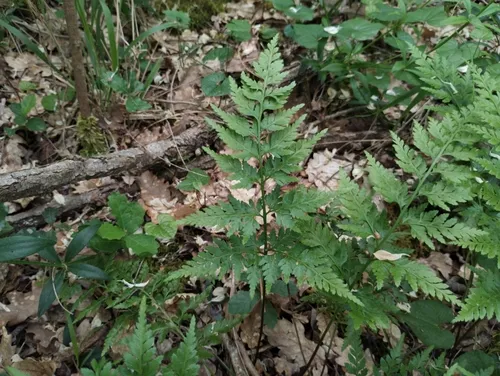
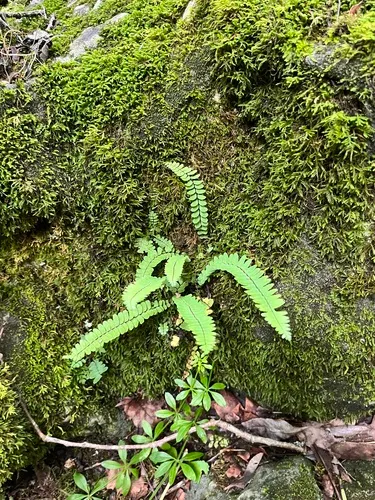
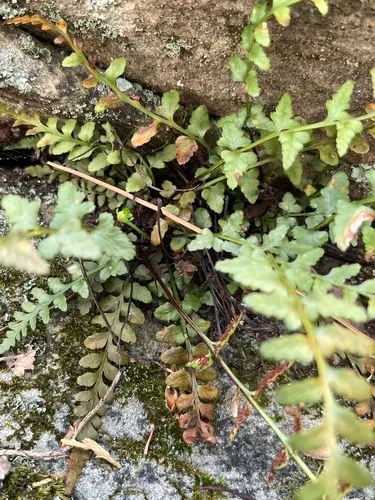
Asplenium montanum, commonly known as the mountain spleenwort, is a small fern endemic to the eastern United States. It is found primarily in the Appalachian Mountains from Vermont to Alabama, with a few isolated populations in the Ozarks and in the Ohio Valley. It grows in small crevices in sandstone cliffs with highly acid soil, where it is usually the only vascular plant occupying that ecological niche. It can be recognized by its tufts of dark blue-green, highly divided leaves. The species was first described in 1810 by the botanist Carl Ludwig Willdenow. No subspecies have been described, although a discolored and highly dissected form was reported from the Shawangunk Mountains in 1974. Asplenium montanum is a diploid member of the "Appalachian Asplenium complex," a group of spleenwort species and hybrids which have formed by reticulate evolution. Members of the complex descended from A. montanum are among the few other vascular plants that can tolerate its typical habitat. Wikipedia →
Growing & care
USDA PLANTS · TRY- Hardiness
- ≥ zone 5 derived from its U.S. range
- Lifespan
- Perennial
Wildlife & pollinators
How pollinator value is scored →❧ Caterpillar hosts Documented caterpillar host
Recorded feeding on Asplenium in North America, including:

Related plants
More Asplenium →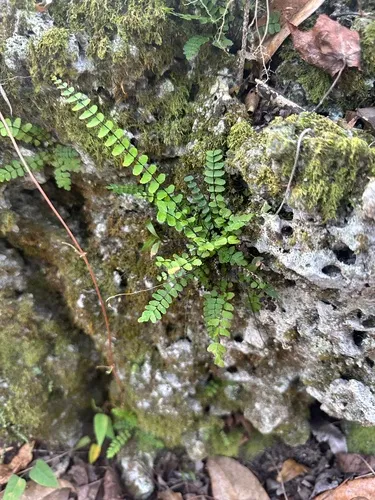
How we know this (1) Methods & honest limits
We take the plant’s U.S. county range and look up each county’s long-term climate, then summarise: native rainfall = the median annual rainfall across its counties; heat tolerance = the warm end (90th percentile) of average temperature across its range (mirroring how our cold-hardiness floor uses an extreme). Counties + medians blunt the roadside/observer bias that makes point-level climate unreliable. Needs at least five placeable counties.
Honest limits: A realized, sampling-biased niche (where it has been recorded, not its physiological optimum), and county climate is coarse — large Western counties span deserts and mountains. Derived guide, never a measured fact.
Sources for this entry (13) Open & cited
Cite this page Open data, please attribute
PlantKey’s data is open under CC BY-SA 4.0 — free to reuse and adapt, with attribution and the same licence. Photos keep their own per-image licence + credit (see Sources above).
Loading…
BibTeX
Loading…