PlantKey Open ecological atlas
Planner
Home / Browse / Avena / Black Oats
iNaturalist — CC, credited & licensed per image
Poaceae family

Black Oats Avena strigosa

Also known as: lopsided oat

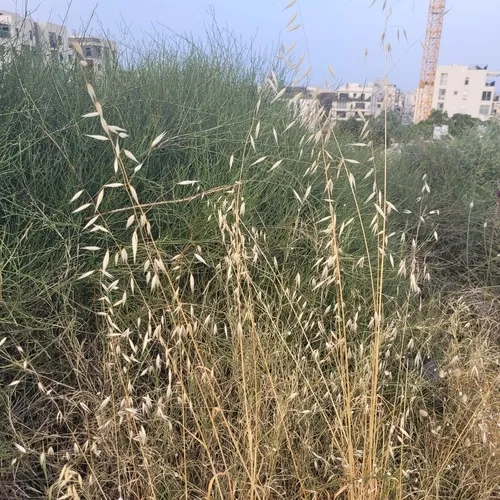
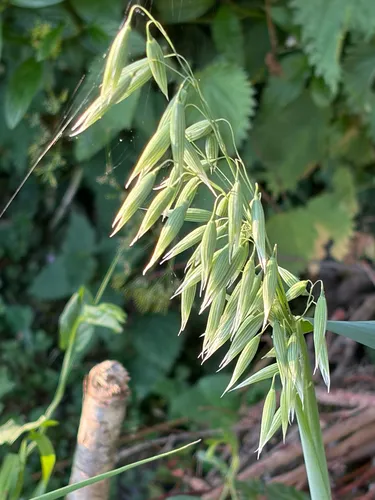
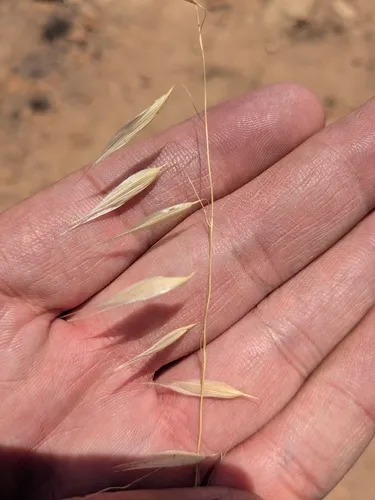
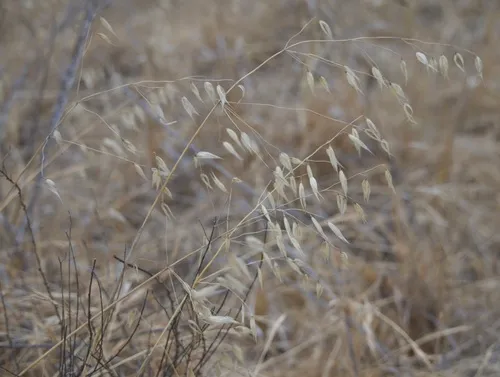
Black Oats is an introduced annual grass, found in the lower 48 states. It grows to 2 ft in part shade – shade.

More about this plant

Avena strigosa is a species of grass native to Europe. It has edible seeds and is often cultivated as animal feed in Portugal and Brazil. It is the only 14-chromosome species of the seven in existence that is grown for profit. It is sometimes reported as a weed. Wikipedia →

Growing & care

USDA PLANTS · TRY
Conditions
Sources · Conditions
USDA PLANTS — Sun
USDA — SoilPH — Soil pH
Cold hardiness (derived) — Hardiness
Sun
Part shade – shade
Soil pH
4.5–7.3
Hardiness
≥ zone 7 derived from its U.S. range
Size & form
Sources · Size & form
USDA PLANTS (DwCA, Zenodo 17903503) — Height, Mature — Height
Derived (allometric) — width = height × functional-class crown ratio fit on USDA Urban Tree DB · Tallo; method per Jucker et al. 2022, Pretzsch et al. 2015 — Mature width
USDA PLANTS (DwCA, Zenodo 17903503) — Planting Density (per acre) — Spacing
USDA PLANTS (DwCA, Zenodo 17903503) — Growth Rate / Spread / Growth Form / Lifespan / Active Growth Period / Seed Period — Growth form · Active growth
USDA PLANTS — Lifespan
TRY Plant Trait Database (CC BY 4.0) · USDA PLANTS — Foliage
Height
2 ft
Mature width
~ 2 ft wide DERIVED derived estimate — open-grown crown allometry (height × growth-form ratio); not a measurement
Spacing
1.5–3 ft apart from USDA planting density
Growth form
Multiple stems
Lifespan
Annual
Foliage
Broadleaf · coarse texture
Active growth
Spring & summer
In the garden
Sources · In the garden
USDA PLANTS (DwCA, Zenodo 17903503) — Propagation Method / Commercial Availability — Propagate by
USDA PLANTS (DwCA, Zenodo 17903503) — Germination (cold stratification) — Seed starting
USDA PLANTS (DwCA, Zenodo 17903503) — Foliage Texture / Browse Palatability / Resprout — Resprouts if cut
Propagate by
Seed
Seed starting
No stratification needed
Resprouts if cut
No
Herb layer — Sits in the herb of a layered food forest or polyculture.Open guide →
Chop-and-drop biomass — Soft, low-density wood is quick-growing and easy to cut back — coppice it and drop the trimmings in place as mulch.Open guide →
derived roles
AI = read by an AI vision model · DERIVED = a computed estimate, not a direct measurement. The “How we know this” section below details each.
When to sow · for your area

Sow timing keys off your local last- and first-frost dates.

Species characteristics from USDA PLANTS (public domain) + TRY (CC BY) — general guidance, not a guarantee for your exact site. Deer "browsing" is documented palatability, not a deer-proof claim.

Wildlife & pollinators

How pollinator value is scored →
❧ Caterpillar hosts ~22 caterpillar species

Avena supports ~22 caterpillar species.

Native butterfly & moth caterpillars are the base of the terrestrial food web — most songbirds rear their young almost entirely on them. As a host for native Lepidoptera this is a moderate genus for introduced plants — native genera typically support far more.

Keystone count (genus-level) from Warren II 2026 (CC0) · Tallamy host-use records. Named species (a documented Nearctic sample, not exhaustive) from NHM HOSTS (CC0).
Species thumbnails re-hosted from iNaturalist — Creative Commons, credited per image (hover for credit). Click any species to see it on iNaturalist. Not exhaustive; many taxa have no openly-licensed photo yet.
How we know this (4) Methods & honest limits
Leaf build Direct fact

We read each species’ measured specific leaf area (leaf area per unit dry weight) from the Global Spectrum dataset and band it: thin & fast (high SLA), medium, or thick & tough (low SLA). The global median is about 10 mm²/mg.

Honest limits: A species-mean from pooled measurements — individual plants vary with light and site. A broad strategy signal, not a precise per-plant figure.

Díaz, S. et al. (2022) The global spectrum of plant form and function: enhanced species-level trait dataset. Scientific Data 9:755.
Growth strategy Derived

We place each species on Grime’s competitor–stress-tolerator–ruderal (C–S–R) triangle using the globally-calibrated “StrateFy” method: leaf size drives the competitor score, dense low-area leaves the stress-tolerator score, and thin high-area leaves the ruderal score. The result is a C/S/R percentage mix and one of 19 strategy classes; we show it in plain words and keep the percentages for the curious.

Honest limits: A species-mean strategy from pooled global leaf measurements — a broad ecological signal, not a precise per-plant or per-site value. Derived, never a measured fact.

Pierce, S. et al. (2017) A global method for calculating plant CSR ecological strategies applied across biomes world-wide. Functional Ecology 31:444–457.
Photosynthesis Direct fact

A recorded categorical fact: each species is tagged C3 (standard), C4 (heat/water-efficient) or CAM (succulent, night-time CO₂ uptake) — or a facultative combination. We only show a trait card for the noteworthy C4/CAM cases; C3 is the unremarkable majority, kept in the data but not surfaced as a card.

Kattge, J. et al. TRY plant trait database — Categorical Traits Dataset (2012).
Mature width Derived

For woody plants that have a height but no measured crown, we estimate width = height × a crown-to-height ratio fit for that plant’s form (conifers narrower than broadleaf trees, shrubs widest), calibrated on our measured open-grown crowns and capped at the largest one ever measured. A measured crown always wins; herbaceous plants get nothing (no anchor).

Honest limits: A coarse class-median estimate for garden-scale spacing, not a measurement; woody single/multi-stem forms only.

Allometric basis: Jucker et al. 2022 (Tallo); Pretzsch et al. 2015; McPherson et al. 2016 (USDA Urban Tree DB).
Derived values are computed from open data by a published method — labelled, cited, and never shown as a direct observation. Full methodology →
Sources for this entry (29) Open & cited
[01] Scientific name & family — USDA PLANTS (DwCA, Zenodo 17903503)
[02] Growth habit & duration — USDA PLANTS (DwCA, Zenodo 17903503)
[03] Native status & distribution — USDA PLANTS (DwCA, Zenodo 17903503)
[04] Common name — USDA PLANTS (via GBIF)
[15] Invasive / introduced status — US-RIIS v2.0 (USGS)
[17] Description — Wikipedia (CC BY-SA)
[18] Ecological value — Warren II 2026 (CC0) · Tallamy host-use counts
[20] Functional traits — TRY Plant Trait Database (CC BY 4.0)
[21] Photosynthetic pathway — TRY Plant Trait Database (CC BY 4.0)
[23] Cold hardiness (derived) — Derived from U.S. range × USDA PHZM zones
[26] Other common names — Wikidata (CC0)
[27] Caterpillar host count — Warren II 2026 (Dryad, CC0) · Tallamy host-use counts
[28] Caterpillar species — NHM HOSTS (CC0)
[29] County range — GBIF Open Data — open-licensed occurrences (CC0/CC-BY) → county
Spot an error or have a better photo? Every field links to its source, and the whole dataset is open.
Cite this page Open data, please attribute

PlantKey’s data is open under CC BY-SA 4.0 — free to reuse and adapt, with attribution and the same licence. Photos keep their own per-image licence + credit (see Sources above).

Citation

Loading…

BibTeX
Loading…