PlantKey Open ecological atlas
Planner
Home / Browse / Barringtonia / Sea Putat
iNaturalist — CC, credited & licensed per image
Lecythidaceae family

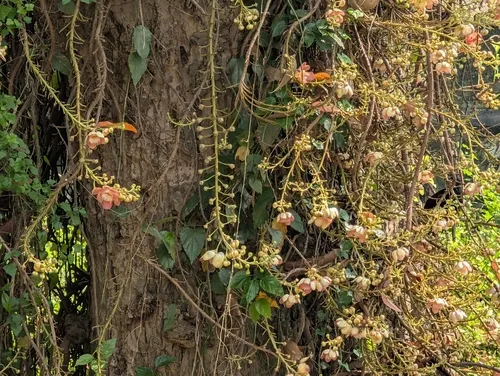
Sea Putat Barringtonia asiatica

Native
Also known as: Beach Barringtonia

Sea Putat is a perennial tree native to the Pacific Basin. It grows to 57 ft.

More about this plant

Barringtonia asiatica, known variously as fish poison tree, putat and beach Barringtonia among other names, is a species of plants in the brazil nut family Lecythidaceae. It is native to coastal habitats from Tanzania and Madagascar in the west to tropical Asia, northern Australia, and islands of the western Pacific Ocean. It was described by Wilhelm Sulpiz Kurz in 1875 and has a conservation status of least concern. It has been used by a number of traditional cultures as a fish poison. Wikipedia →

Growing & care

USDA PLANTS · TRY
Size & form
Sources · Size & form
TRY Plant Trait Database (CC BY 4.0) — Height · Foliage
USDA PLANTS — Lifespan
Height
57 ft
Lifespan
Perennial
Foliage
Deciduous/evergreen broadleaf
In the garden
Canopy layer — Sits in the canopy of a layered food forest or polyculture.Open guide →
derived roles
Species characteristics from USDA PLANTS (public domain) + TRY (CC BY) — general guidance, not a guarantee for your exact site. Deer "browsing" is documented palatability, not a deer-proof claim.
How we know this (1) Methods & honest limits
Leaf build Direct fact

We read each species’ measured specific leaf area (leaf area per unit dry weight) from the Global Spectrum dataset and band it: thin & fast (high SLA), medium, or thick & tough (low SLA). The global median is about 10 mm²/mg.

Honest limits: A species-mean from pooled measurements — individual plants vary with light and site. A broad strategy signal, not a precise per-plant figure.

Díaz, S. et al. (2022) The global spectrum of plant form and function: enhanced species-level trait dataset. Scientific Data 9:755.
Derived values are computed from open data by a published method — labelled, cited, and never shown as a direct observation. Full methodology →
Sources for this entry (16) Open & cited
[01] Scientific name & family — USDA PLANTS (DwCA, Zenodo 17903503)
[02] Growth habit & duration — USDA PLANTS (DwCA, Zenodo 17903503)
[03] Native status & distribution — USDA PLANTS (DwCA, Zenodo 17903503)
[04] Common name — USDA PLANTS (via GBIF)
[05] Invasive / introduced status — USDA PLANTS (DwCA, Zenodo 17903503) — native status
[06] Wetland indicator — USACE National Wetland Plant List (2022)
[08] Description — Wikipedia (CC BY-SA)
[09] Ecological value — GloBI
[12] Functional traits — TRY Plant Trait Database (CC BY 4.0)
[15] Other common names — Wikidata (CC0)
[16] County range — GBIF Open Data — open-licensed occurrences (CC0/CC-BY) → county
Spot an error or have a better photo? Every field links to its source, and the whole dataset is open.
Cite this page Open data, please attribute

PlantKey’s data is open under CC BY-SA 4.0 — free to reuse and adapt, with attribution and the same licence. Photos keep their own per-image licence + credit (see Sources above).

Citation

Loading…

BibTeX
Loading…