Booth's Evening Primrose Camissonia boothii
Booth's Evening Primrose is an annual wildflower native to the lower 48 states. It blooms Mar – Jul. A host for pollen-specialist native bees.
More about this plant
Eremothera boothii is a species of wildflower known as Booth's evening primrose or Booth's sun-cup. This plant is native to the western United States and northwestern Mexico where it is most abundant in arid areas such as deserts. This is an annual plant with hairy reddish-green stems and mottled foliage. The stem ends in a nodding inflorescence of many small flowers which may be white to red or yellowish, often with darker shades on the external surfaces of the four spoon-shaped petals. They have long stamens with clublike yellowish anthers. Flowers of this species tend to open at dusk rather than dawn as in many other Camissonia. The fruit is a twisted capsule one to 3 centimeters long. Plant appearances may vary across subspecies. Wikipedia →
Growing & care
USDA PLANTS · TRY- Hardiness
- ≥ zone 7 derived from its U.S. range
- Lifespan
- Annual
Wildlife & pollinators
How pollinator value is scored →❧ Caterpillar hosts Documented caterpillar host
Recorded feeding on Camissonia in North America, including:


✦ Bees specialist-bee host
Specialist native bees depend on it.
Some native bees are pollen specialists (oligolectic) — they raise young only on pollen from particular plant genera. Camissonia is a recorded specialist-bee host, so losing it can mean losing the bee that relies on it.
Related plants
More Camissonia →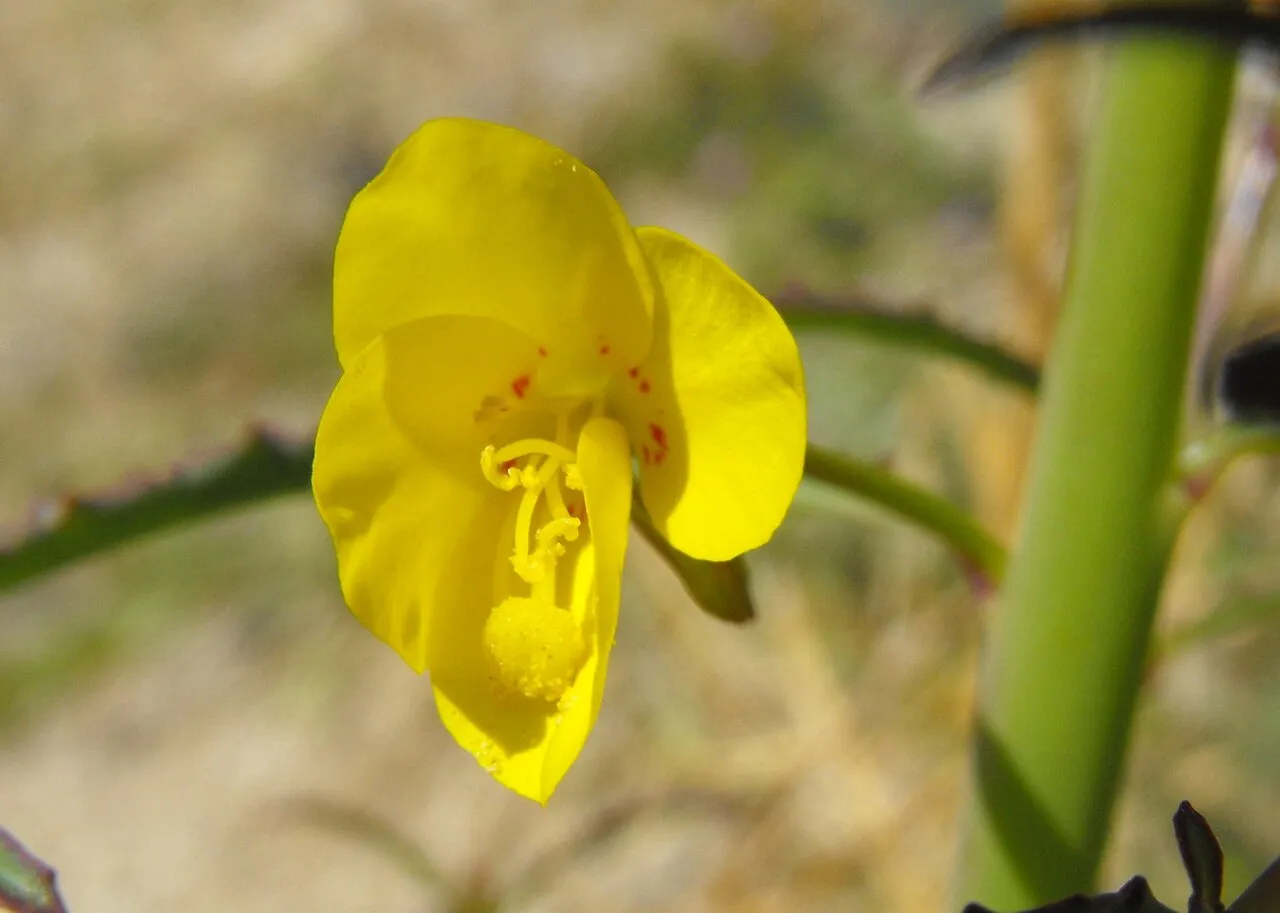
How we know this (1) Methods & honest limits
A recorded categorical fact: each species is tagged C3 (standard), C4 (heat/water-efficient) or CAM (succulent, night-time CO₂ uptake) — or a facultative combination. We only show a trait card for the noteworthy C4/CAM cases; C3 is the unremarkable majority, kept in the data but not surfaced as a card.
Sources for this entry (11) Open & cited
Cite this page Open data, please attribute
PlantKey’s data is open under CC BY-SA 4.0 — free to reuse and adapt, with attribution and the same licence. Photos keep their own per-image licence + credit (see Sources above).
Loading…
BibTeX
Loading…