Santa Cruz Island Suncup Camissonia hirtella
Santa Cruz Island Suncup is an annual wildflower native to the lower 48 states. It blooms Apr – Jul. A host for pollen-specialist native bees.
More about this plant
Camissoniopsis hirtella is a species of evening primrose known by the common name Santa Cruz Island suncup. It is native to California and Baja California, where it grows on the slopes of coastal and inland hills and mountains, especially in areas that have recently burned. It is an annual herb producing a hairy stem up to about half a meter in height. Most of the leaves are located in a basal rosette at ground level and are oval in shape and a few centimeters in length. The nodding inflorescence produces flowers with sepals coated in long, glandular hairs, and bright yellow petals under a centimeter long each. The petals sometimes have red dots at their bases. The fruit is a coiling capsule up to 2 centimeters long. Wikipedia →
Growing & care
USDA PLANTS · TRY- Hardiness
- ≥ zone 11 derived from its U.S. range
- Lifespan
- Annual
- Foliage
- Broadleaf
Wildlife & pollinators
How pollinator value is scored →❧ Caterpillar hosts Documented caterpillar host
Recorded feeding on Camissonia in North America, including:


✦ Bees specialist-bee host
Specialist native bees depend on it.
Some native bees are pollen specialists (oligolectic) — they raise young only on pollen from particular plant genera. Camissonia is a recorded specialist-bee host, so losing it can mean losing the bee that relies on it.
Related plants
More Camissonia →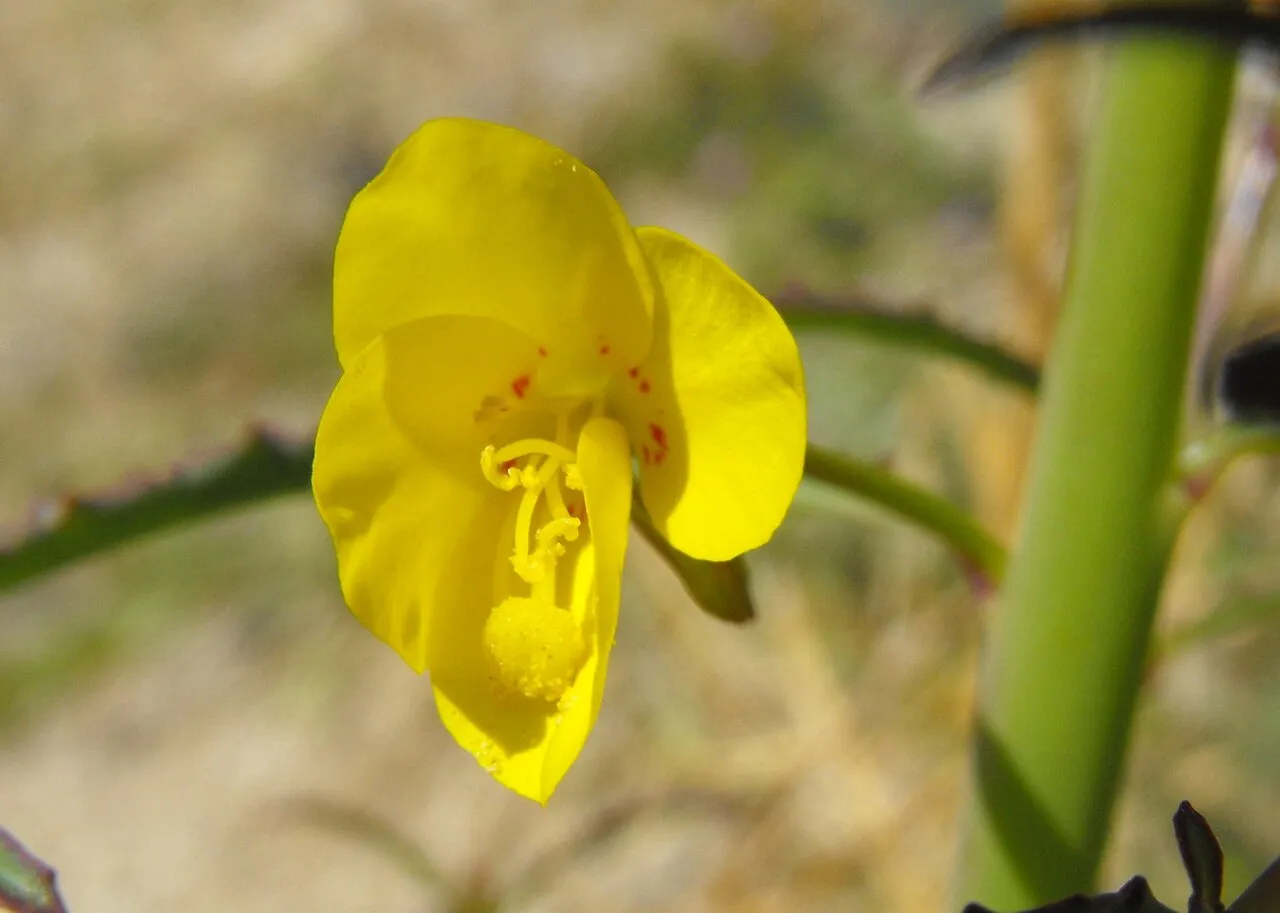
How we know this (1) Methods & honest limits
A recorded categorical fact: each species is tagged C3 (standard), C4 (heat/water-efficient) or CAM (succulent, night-time CO₂ uptake) — or a facultative combination. We only show a trait card for the noteworthy C4/CAM cases; C3 is the unremarkable majority, kept in the data but not surfaced as a card.
Sources for this entry (12) Open & cited
Cite this page Open data, please attribute
PlantKey’s data is open under CC BY-SA 4.0 — free to reuse and adapt, with attribution and the same licence. Photos keep their own per-image licence + credit (see Sources above).
Loading…
BibTeX
Loading…