
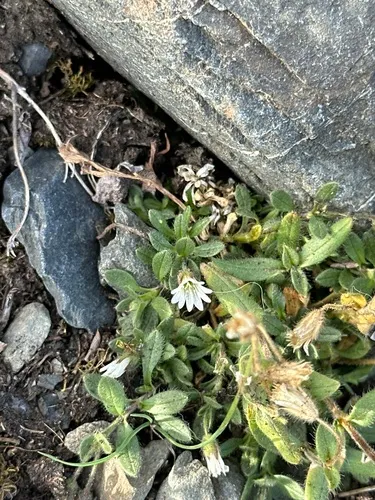
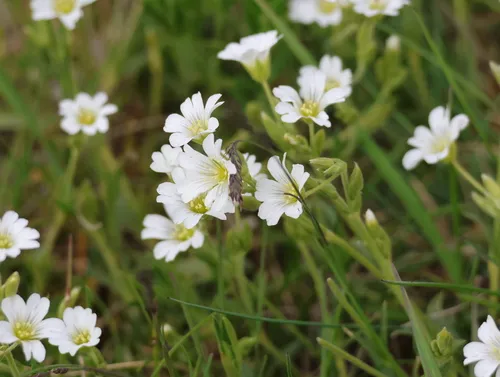
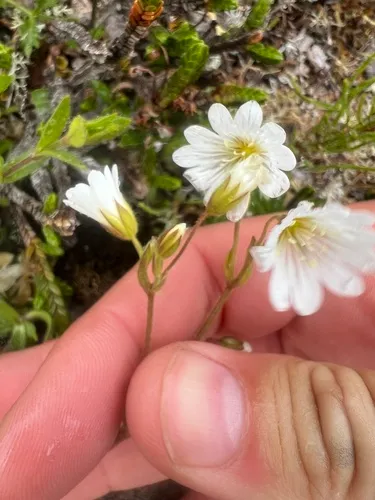
Big Chickweed (subsp. vulgare) Cerastium fontanum subsp. vulgare subspecies
Big Chickweed (subsp. vulgare) is an introduced biennial herb, found in Alaska, Canada, and Greenland. It grows to 0.6 ft.
More about this plant
Cerastium fontanum, also called mouse-ear chickweed, common mouse-ear, or starweed, is a species of mat-forming perennial or, rarely, annual plant. It is native to Europe but introduced elsewhere. Its identifying characteristics are tear-shaped leaves growing opposite one another in a star pattern, hairy leaves, and small white flowers. Mouse-ear chickweed typically grows to 4"-8" tall and spreads horizontally along the ground via the formation of roots wherever the stem falls over and contacts the ground. Wikipedia →
Big Chickweed (subsp. vulgare) is flagged invasive in the U.S. These natives fill a similar niche — same growth habit, bloom season, height, and region — so you keep the look and feed local wildlife instead of spreading a problem.

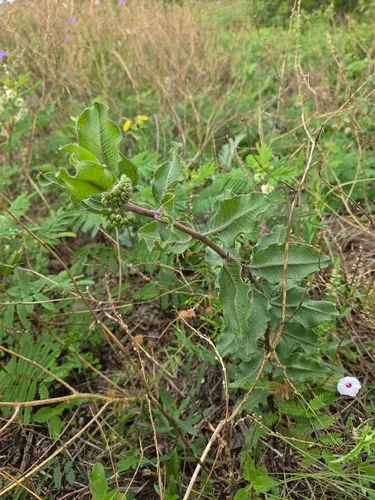
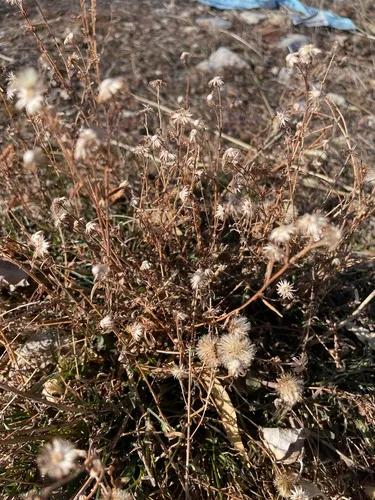
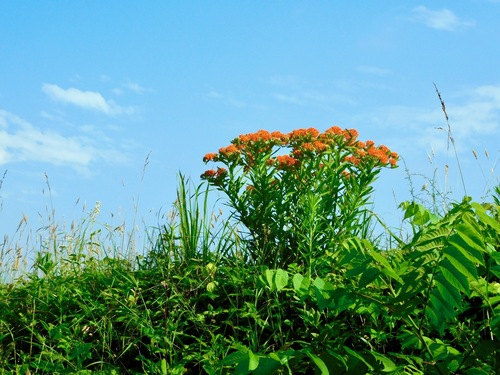
Growing & care
USDA PLANTS · TRY- Hardiness
- ≥ zone 4 derived from its U.S. range
- Height
- 0.6 ft
- Lifespan
- Biennial
- Foliage
- Broadleaf
Wildlife & pollinators
How pollinator value is scored →❧ Caterpillar hosts ~6 caterpillar species
Cerastium supports ~6 caterpillar species.
Native butterfly & moth caterpillars are the base of the terrestrial food web — most songbirds rear their young almost entirely on them. As a host for native Lepidoptera this is a modest genus.
Recorded feeding on Cerastium in North America, including:


Related plants
More Cerastium →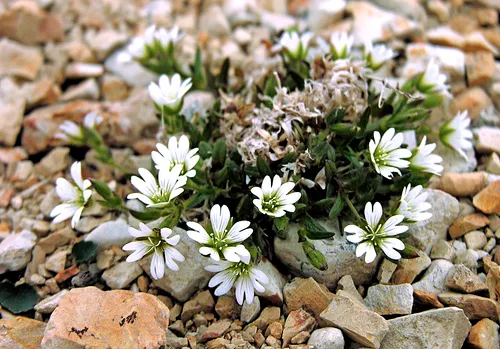
How we know this (2) Methods & honest limits
We read each species’ measured specific leaf area (leaf area per unit dry weight) from the Global Spectrum dataset and band it: thin & fast (high SLA), medium, or thick & tough (low SLA). The global median is about 10 mm²/mg.
Honest limits: A species-mean from pooled measurements — individual plants vary with light and site. A broad strategy signal, not a precise per-plant figure.
We place each species on Grime’s competitor–stress-tolerator–ruderal (C–S–R) triangle using the globally-calibrated “StrateFy” method: leaf size drives the competitor score, dense low-area leaves the stress-tolerator score, and thin high-area leaves the ruderal score. The result is a C/S/R percentage mix and one of 19 strategy classes; we show it in plain words and keep the percentages for the curious.
Honest limits: A species-mean strategy from pooled global leaf measurements — a broad ecological signal, not a precise per-plant or per-site value. Derived, never a measured fact.
Sources for this entry (16) Open & cited
Cite this page Open data, please attribute
PlantKey’s data is open under CC BY-SA 4.0 — free to reuse and adapt, with attribution and the same licence. Photos keep their own per-image licence + credit (see Sources above).
Loading…
BibTeX
Loading…