
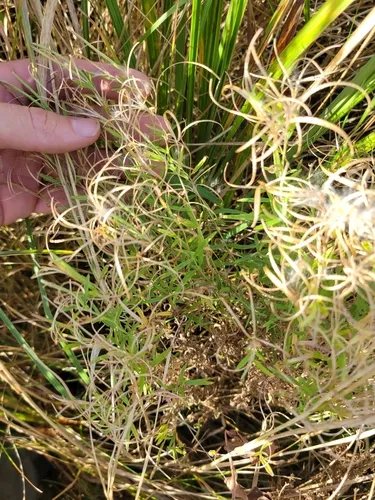
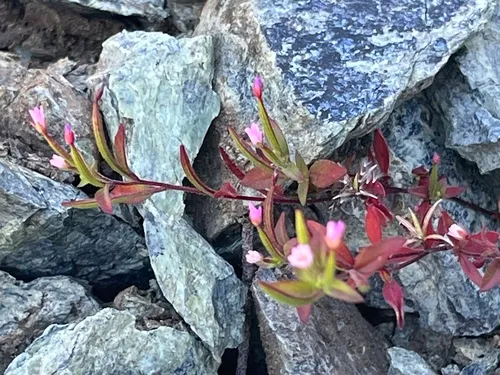
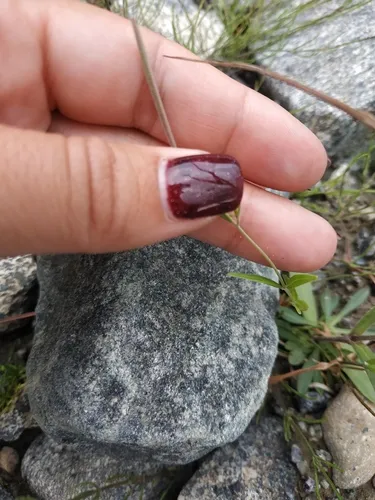
Dwarf Fireweed Chamerion latifolium
Dwarf Fireweed is a perennial shrub native to Alaska, Canada, and Greenland. It blooms Jul – Aug.
More about this plant
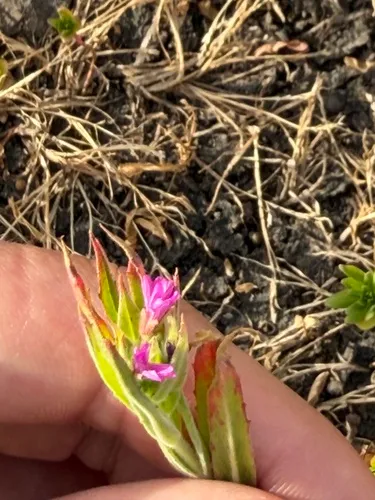
Chamaenerion latifolium is a species of flowering plant in the evening primrose family known by the English common names dwarf fireweed and river beauty willowherb. It has a circumboreal distribution, appearing throughout the northern regions of the Northern Hemisphere, including alpine, sub-Arctic, and Arctic areas such as snowmelt-flooded gravel bars and talus, in a wide range of elevations. This is a perennial herb growing in clumps of leaves variable in size, shape, and texture above a woody caudex. The leaves are 1 to 10 centimeters long, lance-shaped to oval, pointed or rounded at the tips, and hairy to hairless and waxy. The inflorescence is a rough-haired raceme of nodding flowers with bright to deep pink, and occasionally white, petals up to 3 centimeters long. Behind the opened petals are pointed sepals. The fruit is an elongated capsule which may exceed 10 centimeters in length. Wikipedia →
Growing & care
USDA PLANTS · TRY- Hardiness
- ≥ zone 5 derived from its U.S. range
- Lifespan
- Perennial
Wildlife & pollinators
How pollinator value is scored →❧ Caterpillar hosts ~1 caterpillar species
Chamerion supports ~1 caterpillar species.
Native butterfly & moth caterpillars are the base of the terrestrial food web — most songbirds rear their young almost entirely on them. As a host for native Lepidoptera this is a modest genus.
Related plants
More Chamerion →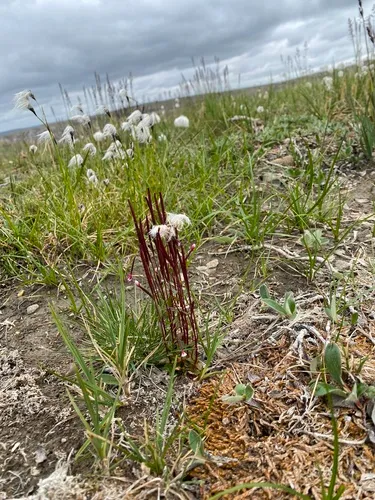
Sources for this entry (11) Open & cited
Cite this page Open data, please attribute
PlantKey’s data is open under CC BY-SA 4.0 — free to reuse and adapt, with attribution and the same licence. Photos keep their own per-image licence + credit (see Sources above).
Loading…
BibTeX
Loading…