PlantKey Open ecological atlas
Planner
Home / Browse / Cheirodendron / Olapalapa
iNaturalist — CC, credited & licensed per image
Araliaceae family

Olapalapa Cheirodendron trigynum

Native
Early-season nectar — Flowers in a late-winter / early-spring window when few other plants in our catalog bloom — valuable early forage for pollinators (relative to our catalog's bloom coverage).

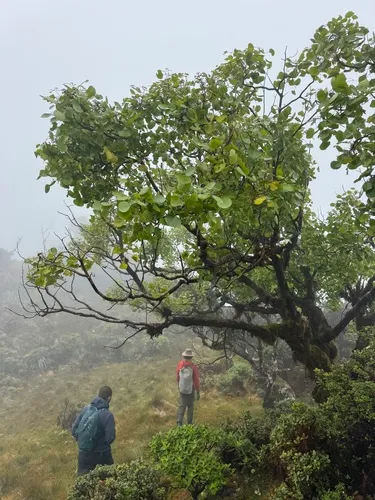
Olapalapa is a perennial tree native to Hawaii. It grows to 27 ft and blooms Jan – Oct.

More about this plant

Cheirodendron trigynum, also known as ʻŌlapa or common cheirodendron, is a species of flowering plant in the ginseng family, Araliaceae, that is endemic to Hawaii. It is a medium-sized tree, reaching a height of 12–15 m (39–49 ft) and a trunk diameter of 0.6 m (2.0 ft). ʻŌlapa inhabits mixed mesic and wet forests at elevations of 310–2,190 m (1,020–7,190 ft) on all main islands, where it is an abundant understory tree. Wikipedia →

Growing & care

USDA PLANTS · TRY
Size & form
Sources · Size & form
TRY Plant Trait Database (CC BY 4.0) — Height · Foliage
USDA PLANTS — Lifespan
Height
27 ft
Lifespan
Perennial
Foliage
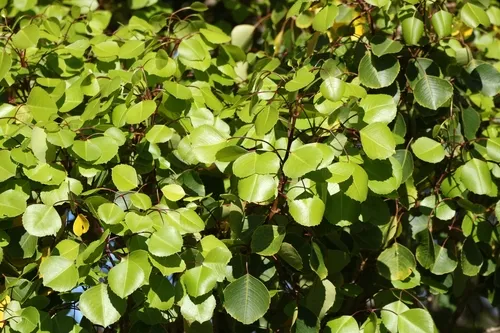
Evergreen broadleaf
In the garden
Sub-canopy / understory layer — Sits in the understory of a layered food forest or polyculture.Open guide →
derived roles
The garden year bloom → fruit → fall colour
J
F
M
A
M
J
J
A
S
O
N
D
Bloom
Bloom (the flower's colour)
Bloom · Jan – Oct — 72 obs · USA-NPN — Nature's Notebook (CC BY 4.0)
Species characteristics from USDA PLANTS (public domain) + TRY (CC BY) — general guidance, not a guarantee for your exact site. Deer "browsing" is documented palatability, not a deer-proof claim.

Wildlife & pollinators

How pollinator value is scored →
Wildlife & visitors 2 birds

Open records of who else uses Olapalapa — a generalist food-web signal, kept separate from the keystone Ecological Value.

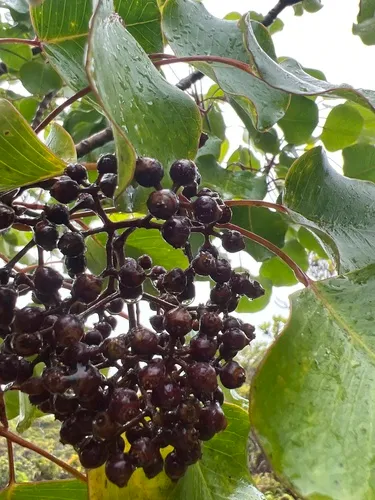
Recorded eaten by 2 birds species (fruit, seed, browse):

Interaction records (observations, not exhaustive) from GloBI → (CC0). Counts are distinct species; names are the most-recorded. Common names from Wikidata (CC0).
How we know this (2) Methods & honest limits
Leaf build Direct fact

We read each species’ measured specific leaf area (leaf area per unit dry weight) from the Global Spectrum dataset and band it: thin & fast (high SLA), medium, or thick & tough (low SLA). The global median is about 10 mm²/mg.

Honest limits: A species-mean from pooled measurements — individual plants vary with light and site. A broad strategy signal, not a precise per-plant figure.

Díaz, S. et al. (2022) The global spectrum of plant form and function: enhanced species-level trait dataset. Scientific Data 9:755.
Photosynthesis Direct fact

A recorded categorical fact: each species is tagged C3 (standard), C4 (heat/water-efficient) or CAM (succulent, night-time CO₂ uptake) — or a facultative combination. We only show a trait card for the noteworthy C4/CAM cases; C3 is the unremarkable majority, kept in the data but not surfaced as a card.

Kattge, J. et al. TRY plant trait database — Categorical Traits Dataset (2012).
Derived values are computed from open data by a published method — labelled, cited, and never shown as a direct observation. Full methodology →
Sources for this entry (17) Open & cited
[01] Scientific name & family — USDA PLANTS (DwCA, Zenodo 17903503)
[02] Growth habit & duration — USDA PLANTS (DwCA, Zenodo 17903503)
[03] Native status & distribution — USDA PLANTS (DwCA, Zenodo 17903503)
[04] Common name — USDA PLANTS (via GBIF)
[05] Invasive / introduced status — USDA PLANTS (DwCA, Zenodo 17903503) — native status
[06] Wetland indicator — USACE National Wetland Plant List (2022)
[08] Description — Wikipedia (CC BY-SA)
[09] Ecological value — GloBI
[11] Conservation rank — NatureServe Explorer (CC BY)
[14] Functional traits — TRY Plant Trait Database (CC BY 4.0)
[15] Photosynthetic pathway — TRY Plant Trait Database (CC BY 4.0)
[16] Wildlife & visitors — GloBI — Global Biotic Interactions (CC0)
[17] County range — GBIF Open Data — open-licensed occurrences (CC0/CC-BY) → county
Spot an error or have a better photo? Every field links to its source, and the whole dataset is open.
Cite this page Open data, please attribute

PlantKey’s data is open under CC BY-SA 4.0 — free to reuse and adapt, with attribution and the same licence. Photos keep their own per-image licence + credit (see Sources above).

Citation

Loading…

BibTeX
Loading…