
Campo Clarkia Clarkia delicata
Campo Clarkia is an annual wildflower native to the lower 48 states. It blooms Apr – Jun. A host for pollen-specialist native bees.
More about this plant
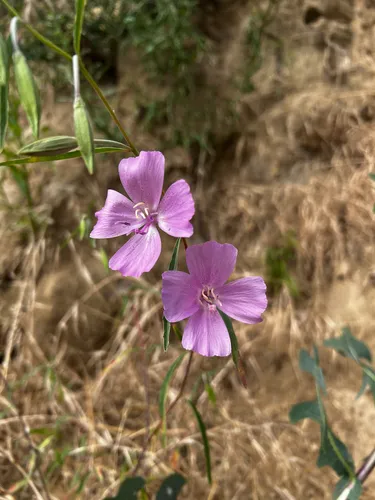
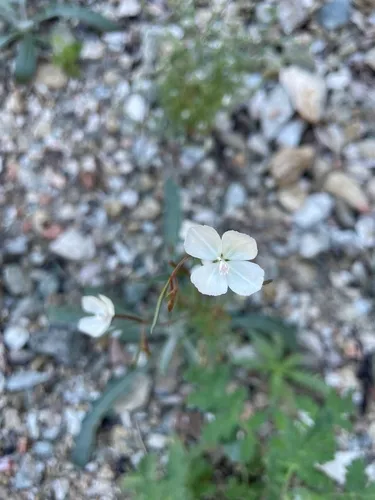
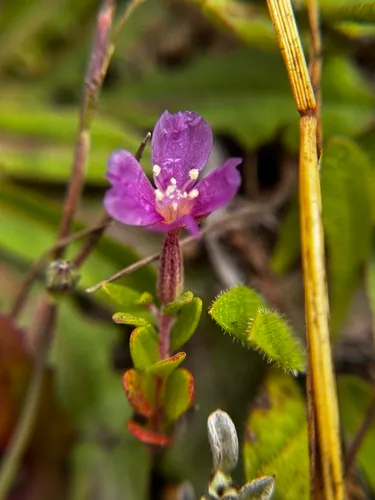
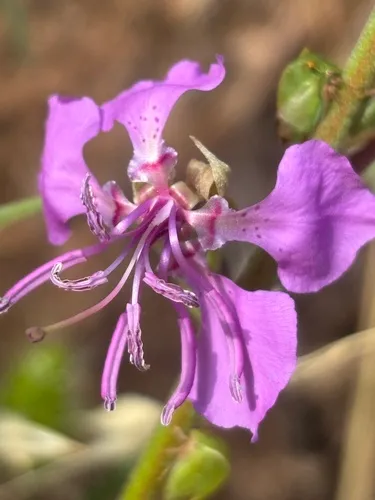
Clarkia delicata is a rare species of flowering plant in the evening primrose family known by the common names Campo clarkia and delicate clarkia. It is native to northern Baja California and adjacent San Diego County, California, where it grows in the woodland and chaparral of the Peninsular Ranges. This is an annual herb producing an erect stem just over half a meter in maximum height. The leaves are oval or widely lance-shaped, up to 4 centimeters long, and borne on very short petioles. The top of the stem is occupied by the inflorescence, in which the lower flowers open while the upper buds hang closed. The sepals remain fused as the flower blooms from one side. Each unlobed oval petal is about a centimeter long and pink to pinkish-lavender. There are 8 stamens, some with large orange anthers and some with smaller, paler anthers. There is also a protruding stigma with four large, fuzzy lobes. Wikipedia →
Growing & care
USDA PLANTS · TRY- Hardiness
- ≥ zone 11 derived from its U.S. range
- Lifespan
- Annual
- Foliage
- Broadleaf
Wildlife & pollinators
How pollinator value is scored →❧ Caterpillar hosts ~3 caterpillar species
Clarkia supports ~3 caterpillar species.
Native butterfly & moth caterpillars are the base of the terrestrial food web — most songbirds rear their young almost entirely on them. As a host for native Lepidoptera this is a modest genus.
Recorded feeding on Clarkia in North America, including:


✦ Bees specialist-bee host
Specialist native bees depend on it.
Some native bees are pollen specialists (oligolectic) — they raise young only on pollen from particular plant genera. Clarkia is a recorded specialist-bee host, so losing it can mean losing the bee that relies on it.
Related plants
More Clarkia →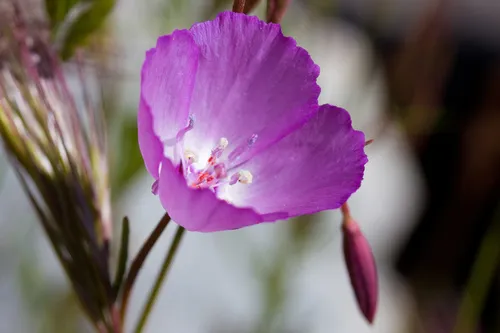
How we know this (1) Methods & honest limits
A recorded categorical fact: each species is tagged C3 (standard), C4 (heat/water-efficient) or CAM (succulent, night-time CO₂ uptake) — or a facultative combination. We only show a trait card for the noteworthy C4/CAM cases; C3 is the unremarkable majority, kept in the data but not surfaced as a card.
Sources for this entry (17) Open & cited
Cite this page Open data, please attribute
PlantKey’s data is open under CC BY-SA 4.0 — free to reuse and adapt, with attribution and the same licence. Photos keep their own per-image licence + credit (see Sources above).
Loading…
BibTeX
Loading…