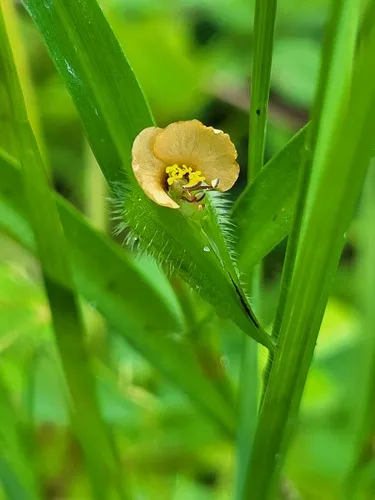
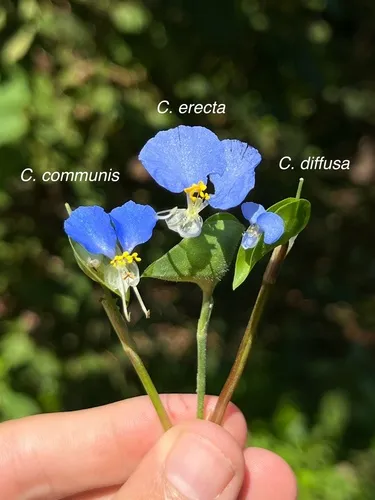
Climbing Dayflower Commelina diffusa f. form
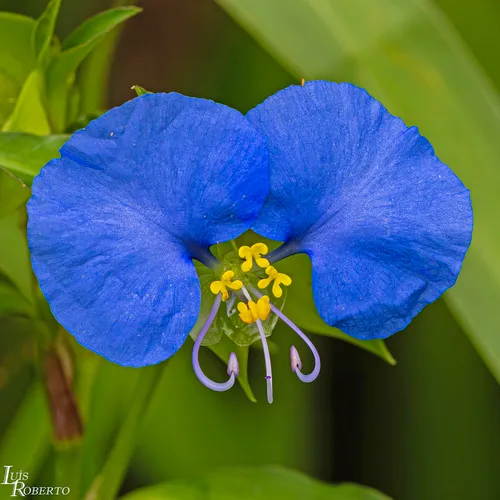
Climbing Dayflower is an annual wildflower native to the lower 48 states, Puerto Rico, and the U.S. Virgin Islands. It grows to 1 ft and blooms Jul in full sun, with brown fruit.
More about this plant
Commelina diffusa, sometimes known as the climbing dayflower or spreading dayflower, is an herbaceous plant in the dayflower family. Its native distribution is Paleotropical, including tropical and southern Africa, Yemen, the Indian Subcontinent, Indochina, Peninsular Malaysia, southern China, Japan, Korea, the Philippines, New Guinea, and the Pacific Islands. It has been introduced throughout the tropical and subtropical Americas, where it is now found from the eastern and midwestern United States to northern Argentina. It has been introduced to the southeastern United States where it is most common in wet disturbed soils. There are two recognised varieties, one being the type and the other being C. diffusa var. gigas, which is native to Asia and has been introduced to Florida. It flowers from spring to fall and is most common in disturbed situations, moist places and forests. In China the plant is used medicinally as a febrifuge and a diuretic. A blue dye is also extracted from the flower for paints. In the Hawaiian Islands, it is known as "honohono grass", although it is technically not a grass. "Honohono" refers to the alternating structure of the leaves. At least one publication lists it as an edible plant in New Guinea. Wikipedia →
Growing & care
USDA PLANTS · TRY- Sun
- Full sun
- Soil & moisture
- Medium moisture
- Soil pH
- 5.2–7.2
- Fertility need
- Medium
- Adapts to
- Medium (loam), Fine (clay)
- Hardiness
- USDA zone 12+
- Height
- 1 ft
- Spacing
- 3–4 ft apart from USDA planting density
- Spread
- Moderate
- Growth rate
- Rapid
- Growth form
- Stoloniferous
- Lifespan
- Annual · short-lived
- Foliage
- coarse texture
- Active growth
- Summer
- Fruit
- Brown
- Propagate by
- Seed, Cuttings, Container, Sprigs
- Seed starting
- No stratification needed
- Seeds ripen
- Summer – Autumn seed-collection / harvest window
- In the trade
- No known commercial source
- Resprouts if cut
- No
Sow timing keys off your local last- and first-frost dates.
Wildlife & pollinators
How pollinator value is scored →❧ Caterpillar hosts ~2 caterpillar species
Commelina supports ~2 caterpillar species.
Native butterfly & moth caterpillars are the base of the terrestrial food web — most songbirds rear their young almost entirely on them. As a host for native Lepidoptera this is a modest genus.
Recorded feeding on Commelina in North America, including:

Related plants
More Commelina →
Sources for this entry (23) Open & cited
Cite this page Open data, please attribute
PlantKey’s data is open under CC BY-SA 4.0 — free to reuse and adapt, with attribution and the same licence. Photos keep their own per-image licence + credit (see Sources above).
Loading…
BibTeX
Loading…