PlantKey Open ecological atlas
Planner
Home / Browse / Crypsis / Foxtail Pricklegrass
Wikimedia Commons — CC, credited & licensed per image
Poaceae family

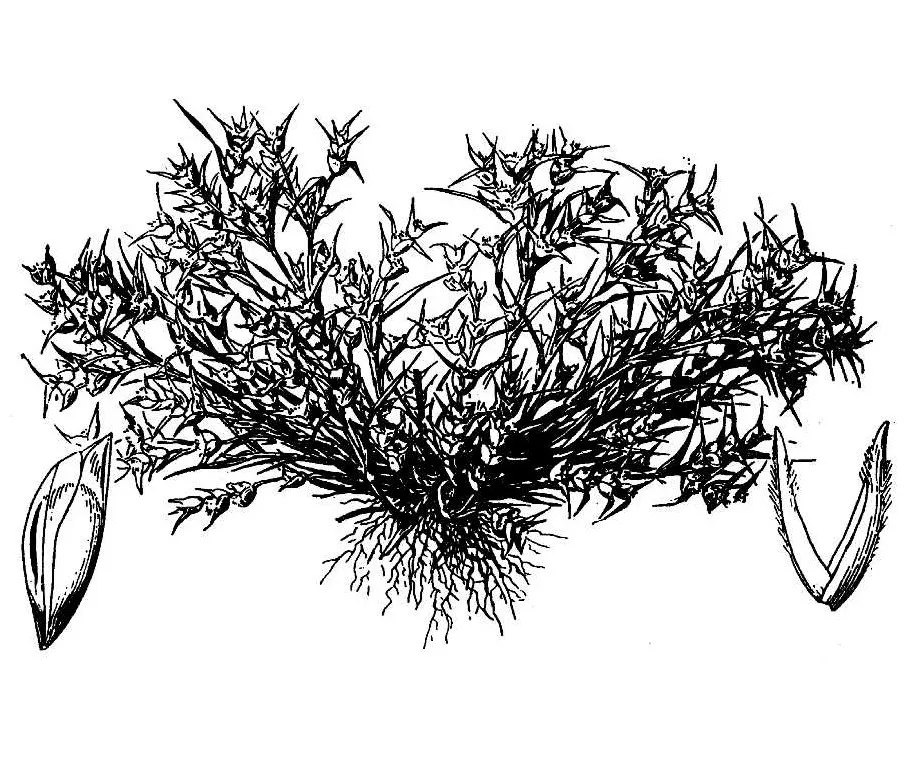
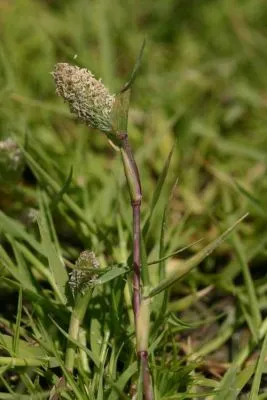
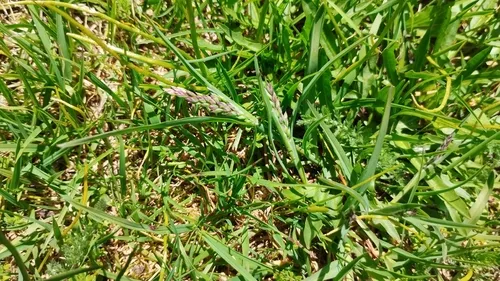
Foxtail Pricklegrass Crypsis alopecuroides

Late-season nectar — Flowers in a late-autumn window when few other plants in our catalog bloom — valuable late forage for pollinators (relative to our catalog's bloom coverage).

Foxtail Pricklegrass is an introduced annual grass, found in the lower 48 states. It blooms Jun – Nov.

More about this plant

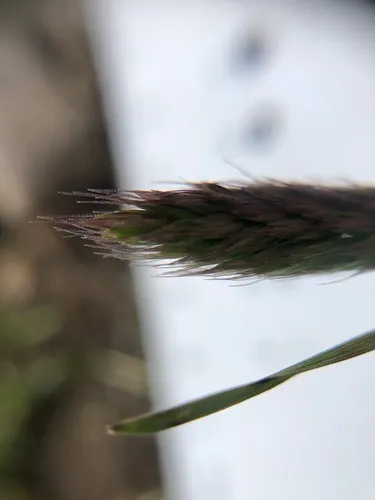
Sporobolus alopecuroides is a species of grass known by the common name foxtail pricklegrass. It is native to Europe, the Middle East, and North Africa. It is also known in the western United States as a common and widespread introduced species, especially in sandy areas around water, such as lakesides. It has also been collected at shipping points near Philadelphia but has not been seen there in about a century. This is an annual grass producing mostly upright and unbranching stems, often dark in color, up to about 75 centimeters in maximum height. The green leaves are up to 12 centimeters long, sometimes waxy in texture. The inflorescence is a dense cylindrical panicle of tiny green to purple spikelets. Wikipedia →

Growing & care

USDA PLANTS · TRY
Conditions
Sources · Conditions
Cold hardiness (derived) — Hardiness
Hardiness
≥ zone 6 derived from its U.S. range
Size & form
Sources · Size & form
USDA PLANTS — Lifespan
TRY Plant Trait Database (CC BY 4.0) — Foliage
Lifespan
Annual
Foliage
Broadleaf
In the garden
Herb layer — Sits in the herb of a layered food forest or polyculture.Open guide →
Rain garden / bioswale — Rated FACW on the wetland list — tolerates wet feet, so it suits the soggy zone of a rain garden or bioswale that catches and filters runoff.Open guide →
derived roles
The garden year bloom → fruit → fall colour
J
F
M
A
M
J
J
A
S
O
N
D
Bloom
Bloom (the flower's colour)
Bloom · Jun – Nov — 45 obs · Herbarium specimens — Park et al. 2023 (CC BY 4.0)
Species characteristics from USDA PLANTS (public domain) + TRY (CC BY) — general guidance, not a guarantee for your exact site. Deer "browsing" is documented palatability, not a deer-proof claim.
How we know this (1) Methods & honest limits
Photosynthesis Direct fact

A recorded categorical fact: each species is tagged C3 (standard), C4 (heat/water-efficient) or CAM (succulent, night-time CO₂ uptake) — or a facultative combination. We only show a trait card for the noteworthy C4/CAM cases; C3 is the unremarkable majority, kept in the data but not surfaced as a card.

Kattge, J. et al. TRY plant trait database — Categorical Traits Dataset (2012).
Derived values are computed from open data by a published method — labelled, cited, and never shown as a direct observation. Full methodology →
Sources for this entry (13) Open & cited
[01] Scientific name & family — USDA PLANTS (DwCA, Zenodo 17903503)
[02] Growth habit & duration — USDA PLANTS (DwCA, Zenodo 17903503)
[03] Native status & distribution — USDA PLANTS (DwCA, Zenodo 17903503)
[04] Common name — USDA PLANTS (via GBIF)
[05] Invasive / introduced status — US-RIIS v2.0 (USGS)
[06] Wetland indicator — USACE National Wetland Plant List (2022)
[08] Description — Wikipedia (CC BY-SA)
[11] Functional traits — TRY Plant Trait Database (CC BY 4.0)
[12] Photosynthetic pathway — TRY Plant Trait Database (CC BY 4.0)
[13] Cold hardiness (derived) — Derived from U.S. range × USDA PHZM zones
Spot an error or have a better photo? Every field links to its source, and the whole dataset is open.
Cite this page Open data, please attribute

PlantKey’s data is open under CC BY-SA 4.0 — free to reuse and adapt, with attribution and the same licence. Photos keep their own per-image licence + credit (see Sources above).

Citation

Loading…

BibTeX
Loading…