
Spiked Larkspur Delphinium stachydeum
Spiked Larkspur is a perennial wildflower native to the lower 48 states. It blooms Jul – Aug.
More about this plant
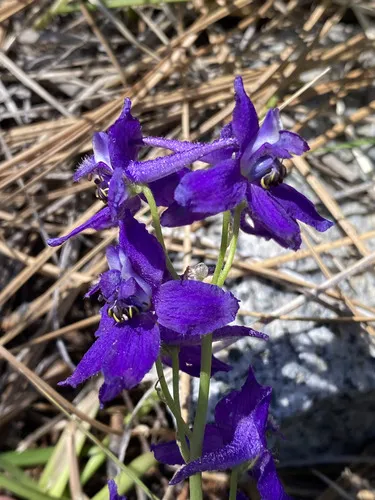
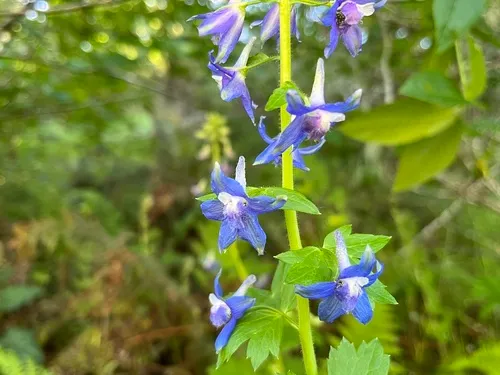
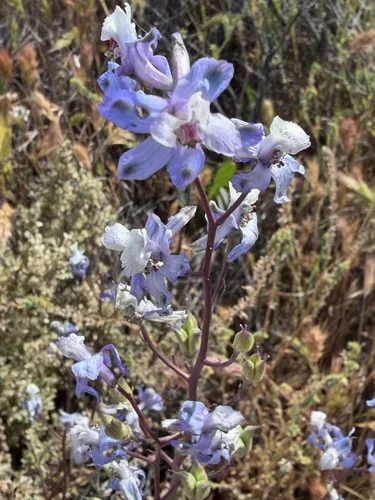
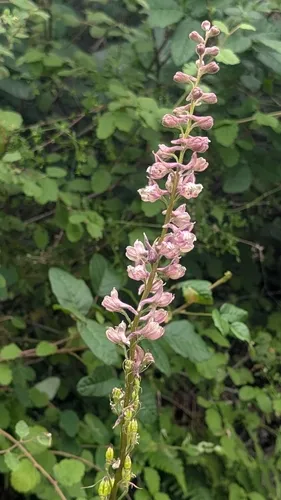
Delphinium stachydeum is a species of larkspur known by the common name spiked larkspur. It is native to the Pacific Northwest and Great Basin of the United States, where it grows in sagebrush scrub and along the edges of mountain forest habitat where it meets prairie and plateau. It is a perennial herb producing at least one erect, slightly hairy stem generally exceeding a meter in height. The multilobed leaves are located mainly on the lower half of the stem except for the area just above ground level. The inflorescence is a branching array of usually more than 30 flowers, each held on a long pedicel. The flower has bright blue sepals around a centimeter long fringed with hairs and surrounding smaller, paler petals. The spur at the back of the flower is just over a centimeter in length. Wikipedia →
Growing & care
USDA PLANTS · TRY- Hardiness
- ≥ zone 7 derived from its U.S. range
- Lifespan
- Perennial
Wildlife & pollinators
How pollinator value is scored →❧ Caterpillar hosts ~10 caterpillar species
Delphinium supports ~10 caterpillar species.
Native butterfly & moth caterpillars are the base of the terrestrial food web — most songbirds rear their young almost entirely on them. As a host for native Lepidoptera this is a moderate genus.
Recorded feeding on Delphinium in North America, including:


+ 8 more species → ↑ show fewer


Related plants
More Delphinium →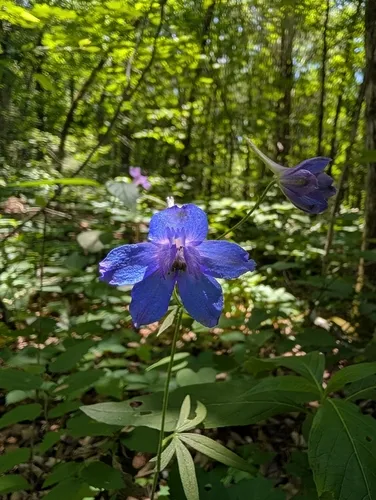
How we know this (1) Methods & honest limits
We take the plant’s U.S. county range and look up each county’s long-term climate, then summarise: native rainfall = the median annual rainfall across its counties; heat tolerance = the warm end (90th percentile) of average temperature across its range (mirroring how our cold-hardiness floor uses an extreme). Counties + medians blunt the roadside/observer bias that makes point-level climate unreliable. Needs at least five placeable counties.
Honest limits: A realized, sampling-biased niche (where it has been recorded, not its physiological optimum), and county climate is coarse — large Western counties span deserts and mountains. Derived guide, never a measured fact.
Sources for this entry (15) Open & cited
Cite this page Open data, please attribute
PlantKey’s data is open under CC BY-SA 4.0 — free to reuse and adapt, with attribution and the same licence. Photos keep their own per-image licence + credit (see Sources above).
Loading…
BibTeX
Loading…