
Fuzzy Pride-of-Rochester Deutzia scabra
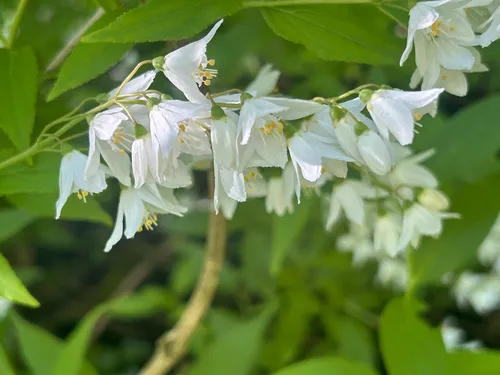
Fuzzy Pride-of-Rochester is an introduced perennial shrub, found in the lower 48 states. It grows to 7 ft and blooms Jun.
More about this plant
Deutzia scabra is a species of flowering plant in the hydrangea family (Hydrangeaceae) native to Japan and introduced to mainland east Asia, Europe, and North America. In its native Japan, it is found from the Kantō region, westward to the islands of Kyushu and Shikoku. Its natural habitat is along forest edges and rocky openings. It is tolerant of disturbance and can be found growing out of stone walls, along roadsides, and in other waste areas. Wikipedia →
Growing & care
USDA PLANTS · TRY- Hardiness
- ≥ zone 5 derived from its U.S. range
- Height
- 7 ft
- Lifespan
- Perennial
- Foliage
- Broadleaf
- Flower colour
- White AI AI image-analysis of community-science photos (~87% expert agreement) — not a botanical record
Wildlife & pollinators
How pollinator value is scored →❧ Caterpillar hosts ~2 caterpillar species
Deutzia supports ~2 caterpillar species.
Native butterfly & moth caterpillars are the base of the terrestrial food web — most songbirds rear their young almost entirely on them. As a host for native Lepidoptera this is a modest genus for introduced plants — native genera typically support far more.
Recorded feeding on Deutzia in North America, including:

✦ Bees 5 bee visitors
5 native & managed bee species are documented visiting Fuzzy Pride-of-Rochester :


Wildlife & visitors 53 birds · 2 nectaring
Open records of who else uses Fuzzy Pride-of-Rochester — a generalist food-web signal, kept separate from the keystone Ecological Value.
Recorded eaten by 53 birds species (fruit, seed, browse) — the most-recorded:


2 adult butterfly & moth species are recorded nectaring at its flowers:


Related plants
More Deutzia →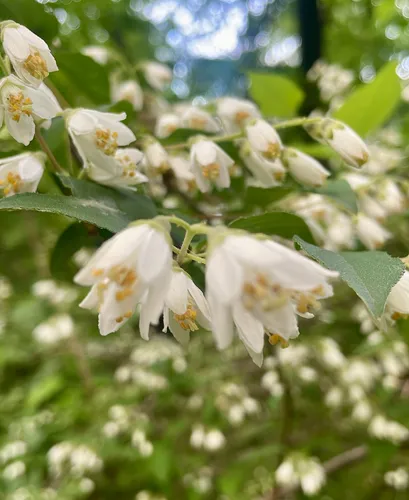

How we know this (3) Methods & honest limits
A recorded categorical fact: each species is tagged C3 (standard), C4 (heat/water-efficient) or CAM (succulent, night-time CO₂ uptake) — or a facultative combination. We only show a trait card for the noteworthy C4/CAM cases; C3 is the unremarkable majority, kept in the data but not surfaced as a card.
We take the plant’s U.S. county range and look up each county’s long-term climate, then summarise: native rainfall = the median annual rainfall across its counties; heat tolerance = the warm end (90th percentile) of average temperature across its range (mirroring how our cold-hardiness floor uses an extreme). Counties + medians blunt the roadside/observer bias that makes point-level climate unreliable. Needs at least five placeable counties.
Honest limits: A realized, sampling-biased niche (where it has been recorded, not its physiological optimum), and county climate is coarse — large Western counties span deserts and mountains. Derived guide, never a measured fact.
McKenzie et al. assigned each species a flower colour with a GPT-4V vision model over iNaturalist photos. We use the confident tier plus a separately-labelled lower-confidence top-up (mostly inconspicuous green/brown flowers), and render it as a small tint — never as an asserted fact, and kept out of the written synopsis.
Honest limits: AI image inference (~87% expert agreement on the confident tier); a decorative, confidence-tiered indicator, not a measured trait.
Sources for this entry (23) Open & cited
Cite this page Open data, please attribute
PlantKey’s data is open under CC BY-SA 4.0 — free to reuse and adapt, with attribution and the same licence. Photos keep their own per-image licence + credit (see Sources above).
Loading…
BibTeX
Loading…