
Tapertip Liveforever Dudleya attenuata
Tapertip Liveforever is a perennial wildflower native to the lower 48 states.
More about this plant
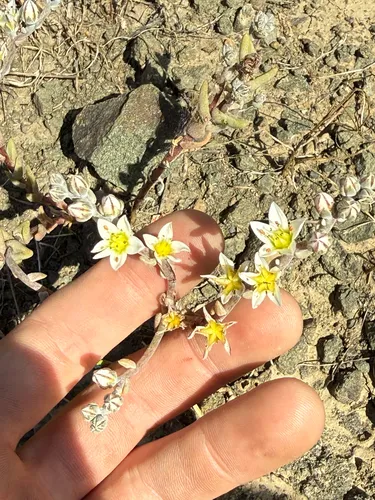
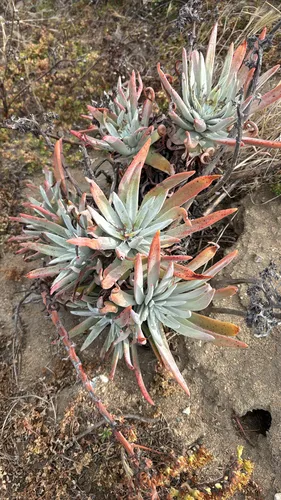
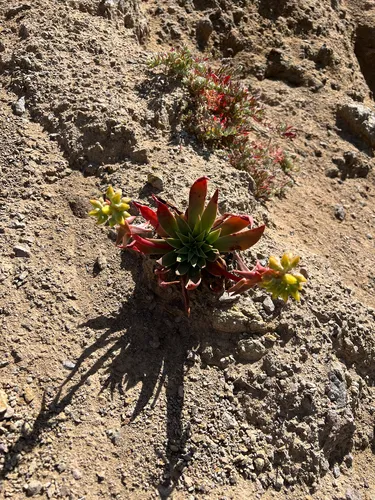
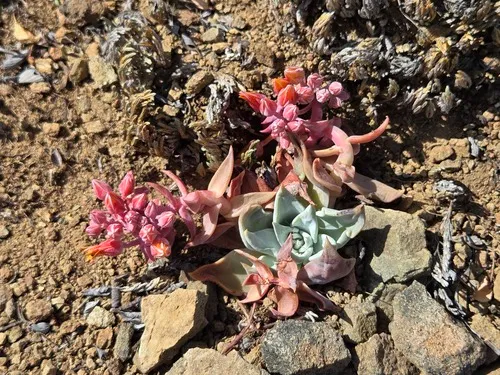
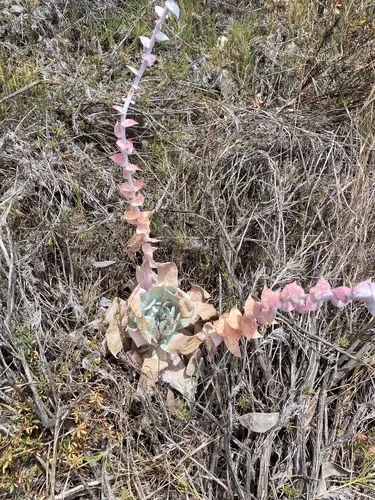
Dudleya attenuata is a species of perennial succulent plant known by the common name taper-tip liveforever, native to Baja California and a small portion of California. It is a rosette-forming leaf succulent which has narrow pencil-shaped leaves that can often be found covered in a white epicuticular wax. The thin, sprawling stems branch to form the clusters of rosettes, with plants creating a "clump" up to 40 cm wide. The small flowers are white or yellow, with 5 spreading petals. It is a diverse, variable species that extends from the southernmost coast of San Diego County to an area slightly north of the Vizcaino Desert, hybridizing with many other species of Dudleya in its range. Some plants with white or pinkish flowers were referred to as Orcutt's liveforever, referring to a former subspecies split on the basis of the flower color. Wikipedia →
Growing & care
USDA PLANTS · TRY- Hardiness
- ≥ zone 11 derived from its U.S. range
- Lifespan
- Perennial
- Foliage
- Evergreen broadleaf
- Flower colour
- Pink AI AI image-analysis of community-science photos — lower-confidence (a more subjective call, often an inconspicuous flower); not a botanical record
Wildlife & pollinators
How pollinator value is scored →❧ Caterpillar hosts Documented caterpillar host
Recorded feeding on Dudleya in North America, including:


Related plants
More Dudleya →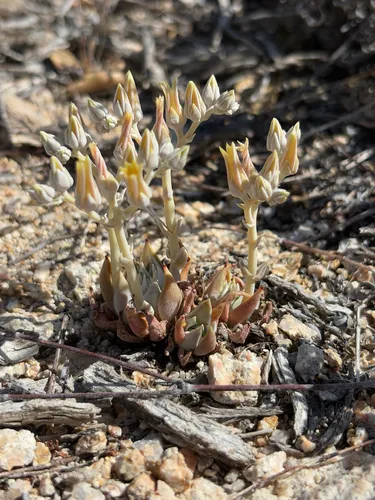
How we know this (2) Methods & honest limits
A recorded categorical fact: each species is tagged C3 (standard), C4 (heat/water-efficient) or CAM (succulent, night-time CO₂ uptake) — or a facultative combination. We only show a trait card for the noteworthy C4/CAM cases; C3 is the unremarkable majority, kept in the data but not surfaced as a card.
McKenzie et al. assigned each species a flower colour with a GPT-4V vision model over iNaturalist photos. We use the confident tier plus a separately-labelled lower-confidence top-up (mostly inconspicuous green/brown flowers), and render it as a small tint — never as an asserted fact, and kept out of the written synopsis.
Honest limits: AI image inference (~87% expert agreement on the confident tier); a decorative, confidence-tiered indicator, not a measured trait.
Sources for this entry (15) Open & cited
Cite this page Open data, please attribute
PlantKey’s data is open under CC BY-SA 4.0 — free to reuse and adapt, with attribution and the same licence. Photos keep their own per-image licence + credit (see Sources above).
Loading…
BibTeX
Loading…