
Fingertips Dudleya edulis
Fingertips is a perennial wildflower native to the lower 48 states. It blooms Apr – Jul.
More about this plant
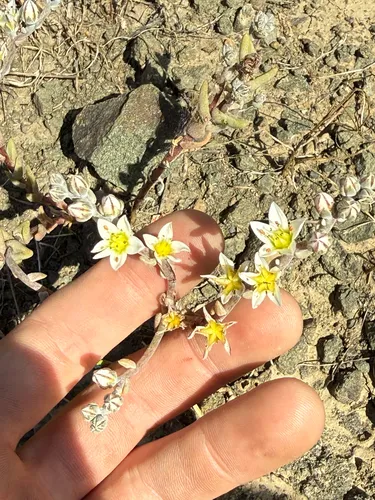
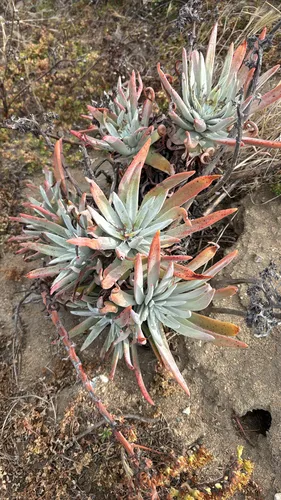
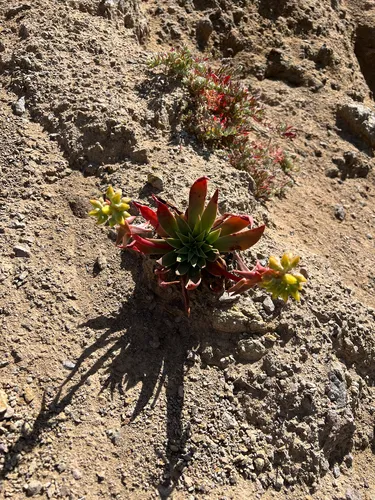
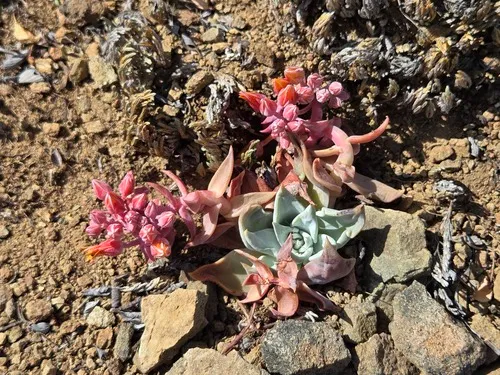
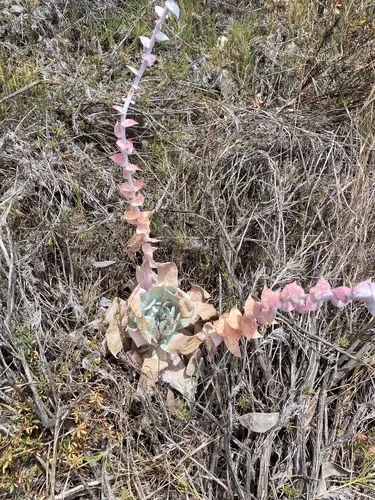
Dudleya edulis is a species of perennial, succulent flowering plant of the Crassulaceae, known by the common names fingertips, lady-fingers, mission lettuce, or simply the San Diego dudleya. The common name "fingertips" denotes the finger-like shape of the leaves; the specific epithet edulis refers to the Kumeyaay people's traditional foraging and consumption of the plant's young scapes. Dudleya edulis is native to the dry, coastal cliffs and chaparral hills of Southern California and northern Baja California, where it has adapted to absorb as much moisture as possible from the nightly fog and marine layer which forms over the Pacific Ocean and gradually moves slightly inland, typically covering all plants and stationary objects in dew. In addition to its inherent drought-tolerance and xeric qualities, this species is also highly salt-tolerant, as it grows almost exclusively facing the ocean, often in exposed settings where it is subjected to regular periods of extreme wind and weather. The species may be found growing on rocky hillsides, sandstone sea cliffs, chaparral habitat, arid canyons, or rooted between exposed, bare rock crevices. Wikipedia →
Growing & care
USDA PLANTS · TRY- Hardiness
- ≥ zone 11 derived from its U.S. range
- Lifespan
- Perennial
- Foliage
- Broadleaf
Wildlife & pollinators
How pollinator value is scored →❧ Caterpillar hosts Documented caterpillar host
Recorded feeding on Dudleya in North America, including:


✦ Bees 5 bee visitors
5 native & managed bee species are documented visiting Fingertips :


Wildlife & visitors 1 nectaring
Open records of who else uses Fingertips — a generalist food-web signal, kept separate from the keystone Ecological Value.
1 adult butterfly & moth species is recorded nectaring at its flowers:

Related plants
More Dudleya →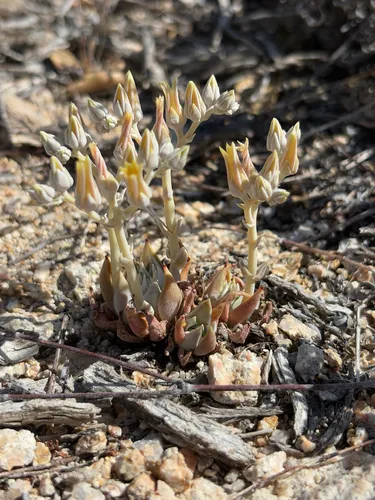
How we know this (1) Methods & honest limits
A recorded categorical fact: each species is tagged C3 (standard), C4 (heat/water-efficient) or CAM (succulent, night-time CO₂ uptake) — or a facultative combination. We only show a trait card for the noteworthy C4/CAM cases; C3 is the unremarkable majority, kept in the data but not surfaced as a card.
Sources for this entry (20) Open & cited
Cite this page Open data, please attribute
PlantKey’s data is open under CC BY-SA 4.0 — free to reuse and adapt, with attribution and the same licence. Photos keep their own per-image licence + credit (see Sources above).
Loading…
BibTeX
Loading…