
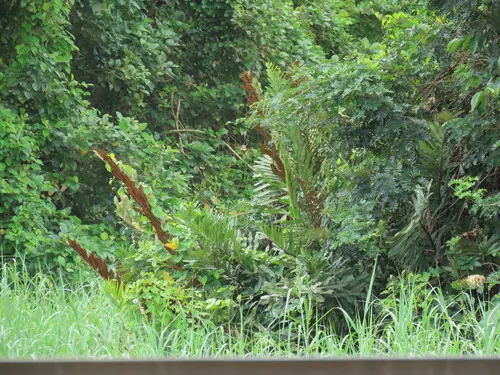
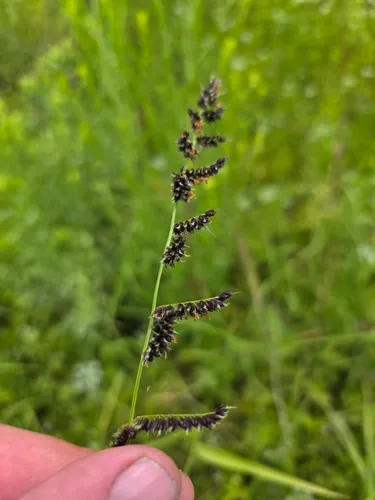
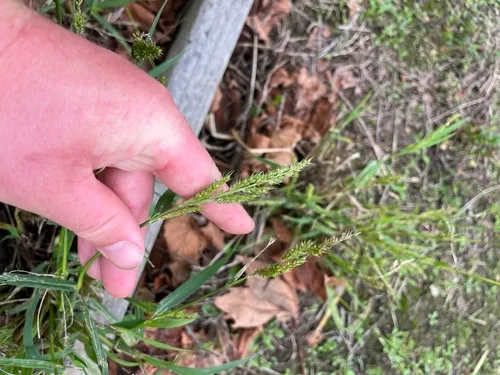
Billion-dollar Grass Echinochloa frumentacea
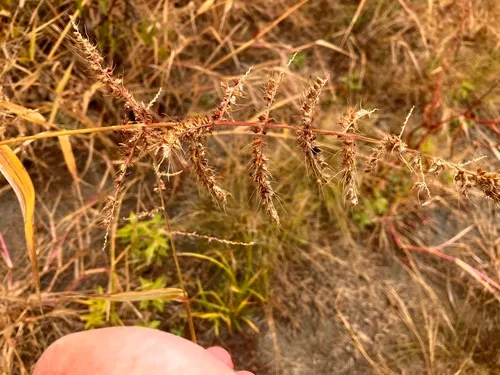
Billion-dollar Grass is an introduced annual grass, found in Canada and the lower 48 states. It grows to 3.9 ft and blooms May in part shade – shade, with yellow fruit.
More about this plant
Echinochloa frumentacea is a species of Echinochloa. Both Echinochloa frumentacea and E. esculenta are called Japanese millet. This millet is widely grown as a cereal in India, Pakistan, and Nepal. Its wild ancestor is the tropical grass Echinochloa colona, but the exact date or region of domestication is uncertain. It is cultivated on marginal lands where rice and other crops will not grow well. The grains are cooked in water, like rice, or boiled with milk and sugar. Sometimes it is fermented to make beer. While also being part of the staple diet for some communities in India, these seeds are, in particular, eaten during religious fasting. For this reason, these seeds are commonly also referred to as "vrat ke chawal" in Hindi. Also, in India, the barnyard millet is known as Sama ke chawal/ Samak chawal/ Sama rice/ Samak rice. Other common names to identify these seeds include oodalu (ಊದಲು) in Kannada, Shyamak (শ্যামাক) or Shyama Chal in Bangla, jhangora in the Garhwal Hills, bhagar (भगर) in Marathi-speaking areas, samo or morio seeds in Gujarati, bonthasaamalu (బొంతసామలు) in Telugu, and kuthiraivaali (குதிரைவாளி) in Tamil. Wikipedia →
Growing & care
USDA PLANTS · TRY- Sun
- Part shade – shade
- Soil & moisture
- Medium moisture
- Soil pH
- 4.7–7.4
- Fertility need
- Medium
- Adapts to
- Medium (loam), Fine (clay)
- Hardiness
- USDA zone 11+
- Height
- 3.9 ft
- Spread
- None — clumping
- Growth rate
- Rapid
- Growth form
- Bunch
- Lifespan
- Annual
- Foliage
- Broadleaf · medium texture
- Active growth
- Spring
- Fruit
- Yellow
- Propagate by
- Seed
- Seed starting
- No stratification needed
- Seeds ripen
- Summer – Autumn seed-collection / harvest window
- In the trade
- Routinely available
- Deer browsing
- Medium moderately palatable
- Resprouts if cut
- No
Sow timing keys off your local last- and first-frost dates.
Wildlife & pollinators
How pollinator value is scored →❧ Caterpillar hosts ~5 caterpillar species
Echinochloa supports ~5 caterpillar species.
Native butterfly & moth caterpillars are the base of the terrestrial food web — most songbirds rear their young almost entirely on them. As a host for native Lepidoptera this is a modest genus.
Recorded feeding on Echinochloa in North America, including:

Related plants
More Echinochloa →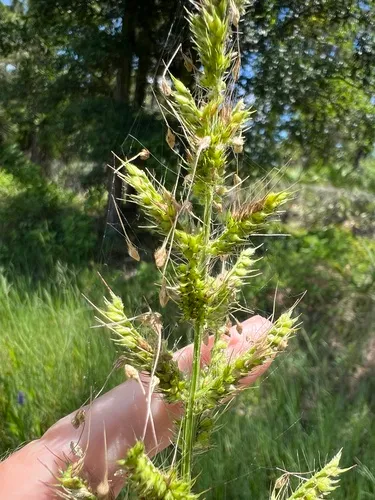
How we know this (2) Methods & honest limits
A recorded categorical fact: each species is tagged C3 (standard), C4 (heat/water-efficient) or CAM (succulent, night-time CO₂ uptake) — or a facultative combination. We only show a trait card for the noteworthy C4/CAM cases; C3 is the unremarkable majority, kept in the data but not surfaced as a card.
We take the plant’s U.S. county range and look up each county’s long-term climate, then summarise: native rainfall = the median annual rainfall across its counties; heat tolerance = the warm end (90th percentile) of average temperature across its range (mirroring how our cold-hardiness floor uses an extreme). Counties + medians blunt the roadside/observer bias that makes point-level climate unreliable. Needs at least five placeable counties.
Honest limits: A realized, sampling-biased niche (where it has been recorded, not its physiological optimum), and county climate is coarse — large Western counties span deserts and mountains. Derived guide, never a measured fact.
Sources for this entry (30) Open & cited
Cite this page Open data, please attribute
PlantKey’s data is open under CC BY-SA 4.0 — free to reuse and adapt, with attribution and the same licence. Photos keep their own per-image licence + credit (see Sources above).
Loading…
BibTeX
Loading…