PlantKey Open ecological atlas
Planner
Home / Browse / Eleocharis / Rooted Spikerush
Wikimedia Commons — CC, credited & licensed per image
Cyperaceae family

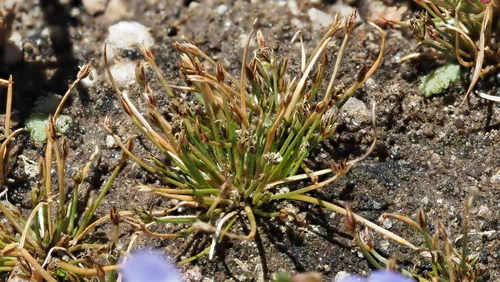
Rooted Spikerush Eleocharis radicans

Native

Rooted Spikerush is a perennial grass native to the lower 48 states and Puerto Rico. It blooms Apr – Oct.

More about this plant

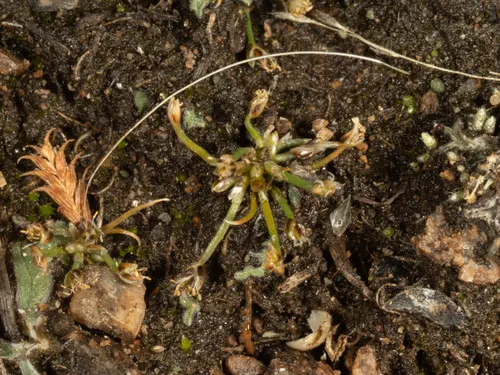
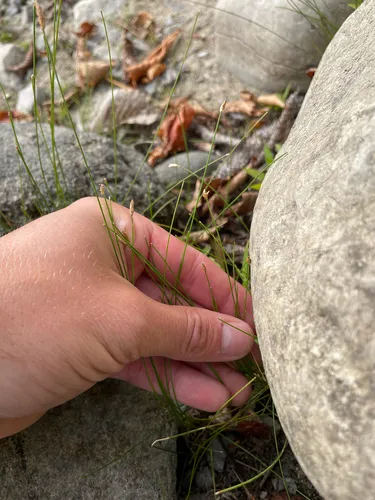
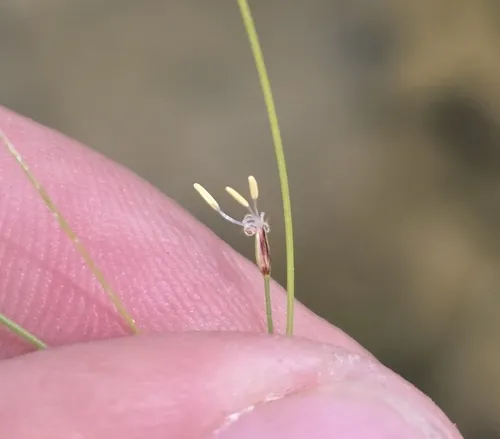
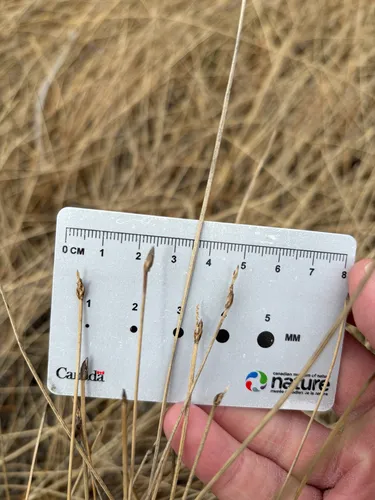
Eleocharis radicans is a species of spikesedge known by the common name rooted spikerush. This aquatic or semi-aquatic plant is native to the Americas as far north as Virginia and northern California. It grows in wet places such as streams, lakes, bogs, and moist meadows, where it roots on soaked ground or floats in the water. This is a rhizomatous, mat-forming perennial with thread-thin, spongy stems. It may have several thin leaves. The stems are topped with papery spikelets about half a centimeter long at maximum size and containing 4 to 12 flowers, each covered with a light-colored bract. The fruit is a minute white or yellow achene less than a millimeter long. Wikipedia →

Growing & care

USDA PLANTS · TRY
Conditions
Sources · Conditions
Cold hardiness (derived) — Hardiness
Hardiness
≥ zone 7 derived from its U.S. range
Size & form
Sources · Size & form
USDA PLANTS — Lifespan
Lifespan
Perennial
In the garden
Herb layer — Sits in the herb of a layered food forest or polyculture.Open guide →
Rain garden / bioswale — Rated OBL on the wetland list — tolerates wet feet, so it suits the soggy zone of a rain garden or bioswale that catches and filters runoff.Open guide →
derived roles
The garden year bloom → fruit → fall colour
J
F
M
A
M
J
J
A
S
O
N
D
Bloom
Bloom (the flower's colour)
Bloom · Apr – Oct — 48 obs · Herbarium specimens — Park et al. 2023 (CC BY 4.0)
Species characteristics from USDA PLANTS (public domain) + TRY (CC BY) — general guidance, not a guarantee for your exact site. Deer "browsing" is documented palatability, not a deer-proof claim.

Wildlife & pollinators

How pollinator value is scored →
❧ Caterpillar hosts Documented caterpillar host
Named species (a documented Nearctic sample, not exhaustive) from NHM HOSTS (CC0).
Species thumbnails re-hosted from iNaturalist — Creative Commons, credited per image (hover for credit). Click any species to see it on iNaturalist. Not exhaustive; many taxa have no openly-licensed photo yet.
Sources for this entry (13) Open & cited
[01] Scientific name & family — USDA PLANTS (DwCA, Zenodo 17903503)
[02] Growth habit & duration — USDA PLANTS (DwCA, Zenodo 17903503)
[03] Native status & distribution — USDA PLANTS (DwCA, Zenodo 17903503)
[04] Common name — USDA PLANTS (via GBIF)
[05] Invasive / introduced status — US-RIIS v2.0 (USGS)
[06] Wetland indicator — USACE National Wetland Plant List (2022)
[08] Description — Wikipedia (CC BY-SA)
[09] Ecological value — GloBI
[11] Conservation rank — NatureServe Explorer (CC BY)
[12] Cold hardiness (derived) — Derived from U.S. range × USDA PHZM zones
[13] Caterpillar species — NHM HOSTS (CC0)
Spot an error or have a better photo? Every field links to its source, and the whole dataset is open.
Cite this page Open data, please attribute

PlantKey’s data is open under CC BY-SA 4.0 — free to reuse and adapt, with attribution and the same licence. Photos keep their own per-image licence + credit (see Sources above).

Citation

Loading…

BibTeX
Loading…