No openly-licensed photo yetWe add Creative-Commons photos from iNaturalist as they’re published.
Cyperaceae family
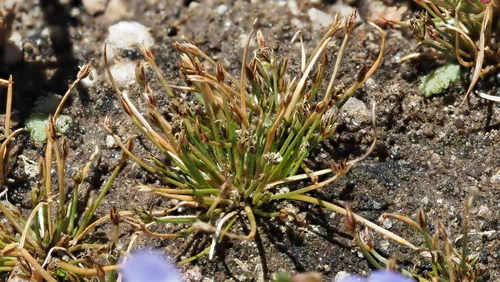
Coastal Plain Spikerush Eleocharis retroflexa
Native
Coastal Plain Spikerush is an annual grass native to the lower 48 states, Puerto Rico, and the U.S. Virgin Islands.
Growing & care
USDA PLANTS · TRY Conditions
Sources · Conditions
Cold hardiness (derived) — Hardiness
- Hardiness
- ≥ zone 9 derived from its U.S. range
Size & form
Sources · Size & form
USDA PLANTS — Lifespan
TRY Plant Trait Database (CC BY 4.0) — Foliage
- Lifespan
- Annual
- Foliage
- Broadleaf
In the garden
Herb layer — Sits in the herb of a layered food forest or polyculture.Open guide →
Rain garden / bioswale — Rated OBL on the wetland list — tolerates wet feet, so it suits the soggy zone of a rain garden or bioswale that catches and filters runoff.Open guide →
derived roles
Species characteristics from USDA PLANTS (public domain) + TRY (CC BY) — general guidance, not a
guarantee for your exact site. Deer "browsing" is documented palatability, not a deer-proof claim.
Wildlife & pollinators
How pollinator value is scored →❧ Caterpillar hosts Documented caterpillar host
Recorded feeding on Eleocharis in North America, including:

Named species (a documented Nearctic sample, not exhaustive) from NHM HOSTS (CC0).
Species thumbnails re-hosted from iNaturalist — Creative Commons, credited per image (hover for credit). Click any species to see it on iNaturalist. Not exhaustive; many taxa have no openly-licensed photo yet.
Related plants
More Eleocharis →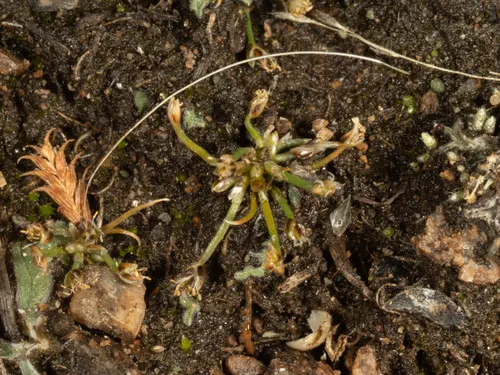
Native
Arizona Spikerush
Eleocharis cancellata
●●●○○ 
Native
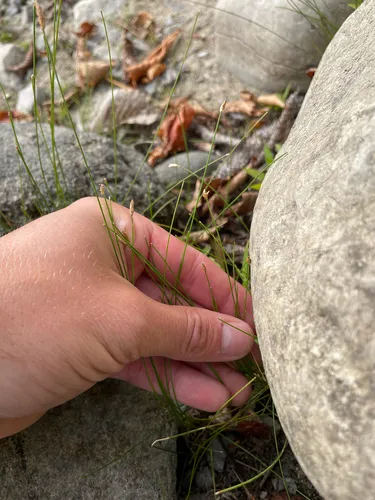
Bald Spikerush
Eleocharis erythropoda
●●●○○ 
Native
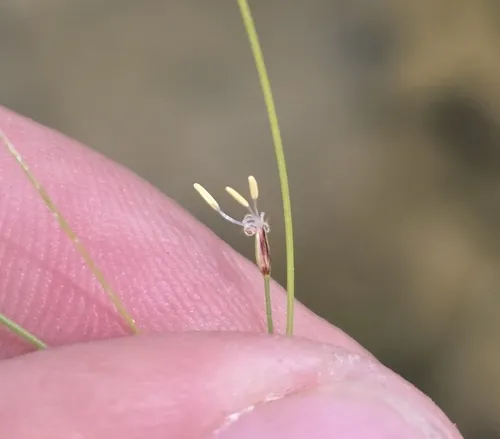
Baldwin's Spikerush
Eleocharis baldwinii
●●●○○ 
Native
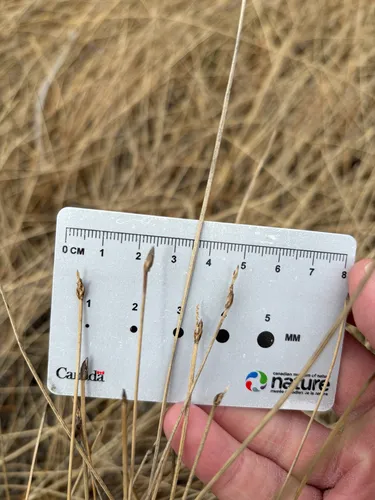
Beaked Spikerush
Eleocharis rostellata
●●●○○ 
Native
Beautiful Spikerush
Eleocharis bella
●●●○○ Native
Black Spikerush
Eleocharis nigrescens
●●●○○ Same genus / family, ranked by ecological value — from the PlantKey catalog
How we know this (1) Methods & honest limits
Photosynthesis Direct fact
A recorded categorical fact: each species is tagged C3 (standard), C4 (heat/water-efficient) or CAM (succulent, night-time CO₂ uptake) — or a facultative combination. We only show a trait card for the noteworthy C4/CAM cases; C3 is the unremarkable majority, kept in the data but not surfaced as a card.
Kattge, J. et al. TRY plant trait database — Categorical Traits Dataset (2012).
Derived values are computed from open data by a published method — labelled, cited, and never shown as a direct observation.
Full methodology →
Sources for this entry (12) Open & cited
[01] Scientific name & family — USDA PLANTS (DwCA, Zenodo 17903503)
[02] Growth habit & duration — USDA PLANTS (DwCA, Zenodo 17903503)
[03] Native status & distribution — USDA PLANTS (DwCA, Zenodo 17903503)
[04] Common name — USDA PLANTS (via GBIF)
[05] Invasive / introduced status — USDA PLANTS (DwCA, Zenodo 17903503) — native status
[06] Wetland indicator — USACE National Wetland Plant List (2022)
[07] Ecological value — GloBI
[08] Conservation rank — NatureServe Explorer (CC BY)
[09] Foliage — TRY Plant Trait Database (CC BY 4.0)
[10] Photosynthetic pathway — TRY Plant Trait Database (CC BY 4.0)
[11] Cold hardiness (derived) — Derived from U.S. range × USDA PHZM zones
[12] Caterpillar species — NHM HOSTS (CC0)
Spot an error or have a better photo? Every field links to its source, and the whole dataset is open.
Cite this page Open data, please attribute
PlantKey’s data is open under CC BY-SA 4.0 — free to reuse and adapt, with attribution and the same licence. Photos keep their own per-image licence + credit (see Sources above).
Citation
Loading…
BibTeX
Loading…