
Sand Lovegrass Eragrostis trichodes
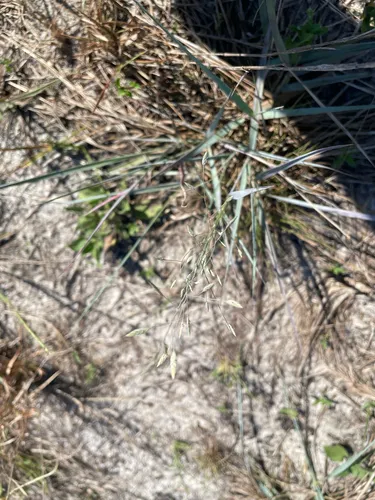
Sand Lovegrass is a perennial grass native to the lower 48 states. It grows to 3.5 ft and blooms May in part shade – shade, with brown fruit.
More about this plant
Eragrostis trichodes, the sand lovegrass, is a warm season perennial bunchgrass native to North America. Wikipedia →
Growing & care
USDA PLANTS · TRY- Sun
- Part shade – shade
- Soil & moisture
- Medium moisture
- Soil pH
- 6–8.5
- Fertility need
- Low
- Adapts to
- Coarse (sandy)
- Hardiness
- USDA zone 5+
- Height
- 3.5 ft
- Spread
- None — clumping
- Growth rate
- Rapid
- Growth form
- Bunch
- Lifespan
- Perennial · short-lived
- Foliage
- Broadleaf · medium texture
- Active growth
- Summer & autumn
- Fruit
- Brown
- Propagate by
- Seed
- Seed starting
- No stratification needed
- Seeds ripen
- Summer – Autumn seed-collection / harvest window
- In the trade
- Routinely available
- Deer browsing
- High browsed readily
- Resprouts if cut
- No
Sow timing keys off your local last- and first-frost dates.
Wildlife & pollinators
How pollinator value is scored →❧ Caterpillar hosts Documented caterpillar host
Recorded feeding on Eragrostis in North America, including:


Related plants
More Eragrostis →
How we know this (2) Methods & honest limits
A recorded categorical fact: each species is tagged C3 (standard), C4 (heat/water-efficient) or CAM (succulent, night-time CO₂ uptake) — or a facultative combination. We only show a trait card for the noteworthy C4/CAM cases; C3 is the unremarkable majority, kept in the data but not surfaced as a card.
We take the plant’s U.S. county range and look up each county’s long-term climate, then summarise: native rainfall = the median annual rainfall across its counties; heat tolerance = the warm end (90th percentile) of average temperature across its range (mirroring how our cold-hardiness floor uses an extreme). Counties + medians blunt the roadside/observer bias that makes point-level climate unreliable. Needs at least five placeable counties.
Honest limits: A realized, sampling-biased niche (where it has been recorded, not its physiological optimum), and county climate is coarse — large Western counties span deserts and mountains. Derived guide, never a measured fact.
Sources for this entry (28) Open & cited
Cite this page Open data, please attribute
PlantKey’s data is open under CC BY-SA 4.0 — free to reuse and adapt, with attribution and the same licence. Photos keep their own per-image licence + credit (see Sources above).
Loading…
BibTeX
Loading…