
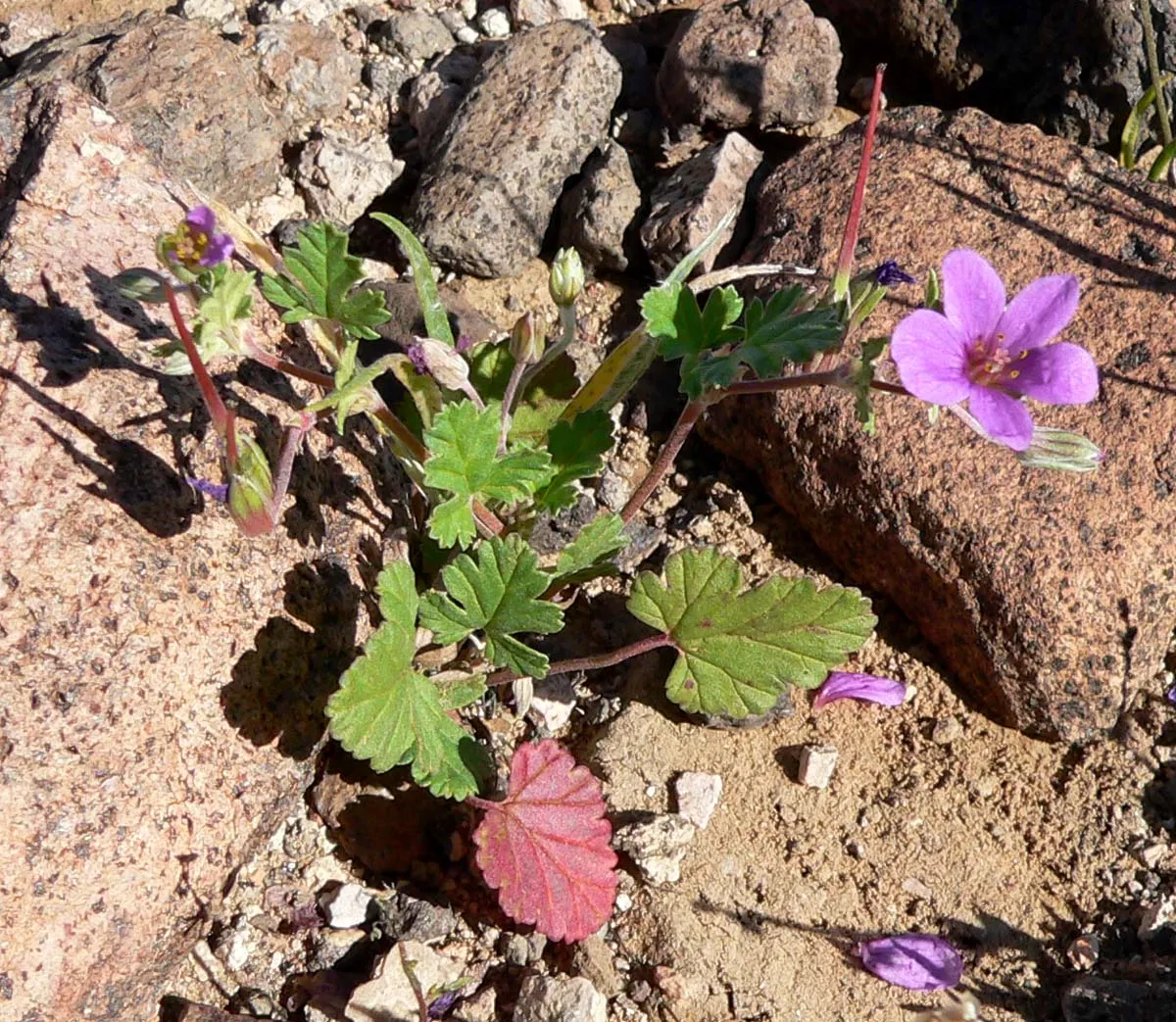
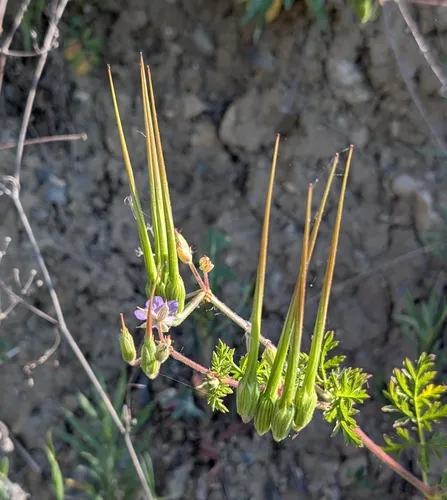
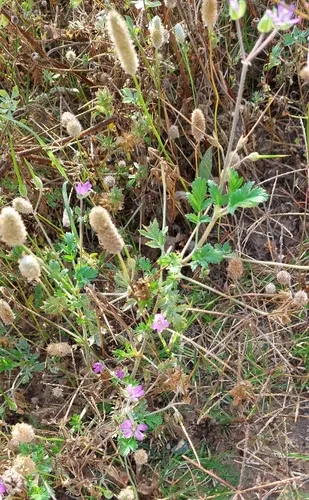
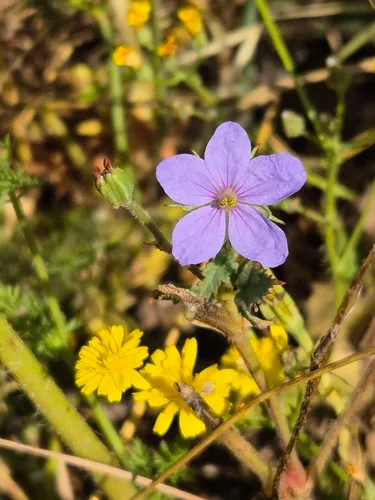
Redstem Stork's Bill Erodium cicutarium
Redstem Stork's Bill is an introduced annual herb, found in Alaska, Canada, and Greenland. It grows to 0.4 ft and blooms Apr – May.
More about this plant
Erodium cicutarium, also known as common stork's-bill, redstem filaree, redstem stork's bill or pinweed, is a herbaceous annual – or in warm climates, biennial – member of the family Geraniaceae of flowering plants. It is native to Macaronesia, temperate Eurasia and north and northeast Africa, and was introduced to North America in the eighteenth century, where it has since become naturalized, particularly in the deserts and arid grasslands of the southwestern United States. It is also naturalized elsewhere, including South America and southern Africa. Wikipedia →
Redstem Stork's Bill is flagged invasive in the U.S. These natives fill a similar niche — same growth habit, bloom season, height, and region — so you keep the look and feed local wildlife instead of spreading a problem.
Part of why it adapts so well: Redstem Stork's Bill is a polyploid complex — multiple chromosome races are on record (2n = 18, 40). Spare genome copies give a plant extra raw material to evolve fast, and polyploidy is a documented correlate of successful plant invasions (te Beest et al. 2012). A labelled association from open cytology (ChromoDB), not a prediction for your specific site.
Growing & care
USDA PLANTS · TRY- Hardiness
- ≥ zone 4 derived from its U.S. range
- Height
- 0.4 ft
- Lifespan
- Annual
- Foliage
- Broadleaf
- Flower colour
- Pink AI AI image-analysis of community-science photos (~87% expert agreement) — not a botanical record
Wildlife & pollinators
How pollinator value is scored →❧ Caterpillar hosts ~3 caterpillar species
Erodium supports ~3 caterpillar species.
Native butterfly & moth caterpillars are the base of the terrestrial food web — most songbirds rear their young almost entirely on them. As a host for native Lepidoptera this is a modest genus for introduced plants — native genera typically support far more.
Recorded feeding on Erodium in North America, including:


+ 2 more species → ↑ show fewer

✦ Bees 27 bee visitors
27 native & managed bee species are documented visiting Redstem Stork's Bill — the 12 most-recorded:


Wildlife & visitors 71 birds · 38 nectaring
Open records of who else uses Redstem Stork's Bill — a generalist food-web signal, kept separate from the keystone Ecological Value.
Recorded eaten by 71 birds species (fruit, seed, browse) — the most-recorded:


38 adult butterfly & moth species are recorded nectaring at its flowers — the most-recorded:


Across 68 U.S. vegetation-survey plots that recorded Redstem Stork's Bill, these catalog species turned up most often in the same plot — a real field co-occurrence signal, not a planting prescription.
Related plants
More Erodium →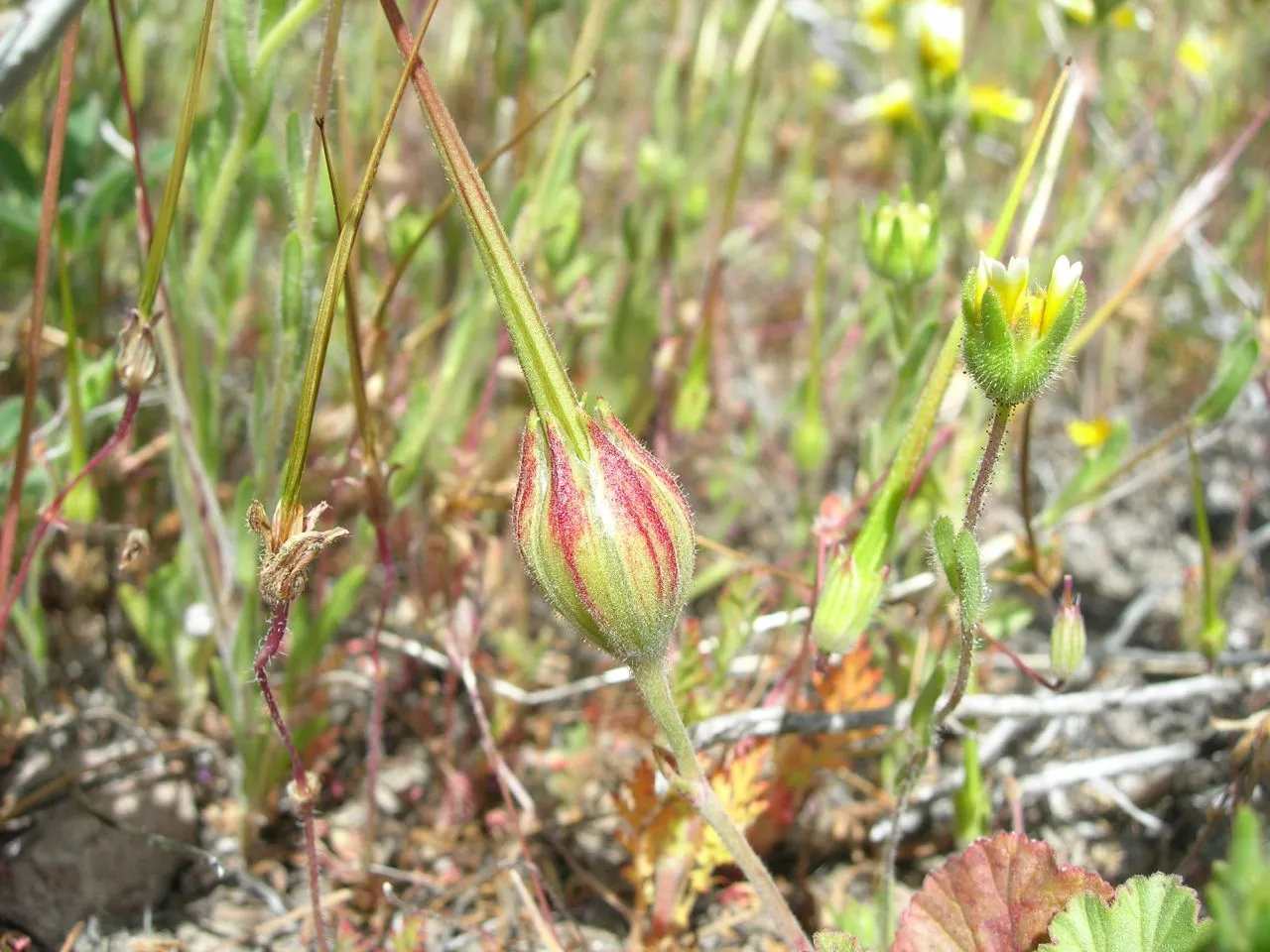
How we know this (5) Methods & honest limits
We read each species’ measured specific leaf area (leaf area per unit dry weight) from the Global Spectrum dataset and band it: thin & fast (high SLA), medium, or thick & tough (low SLA). The global median is about 10 mm²/mg.
Honest limits: A species-mean from pooled measurements — individual plants vary with light and site. A broad strategy signal, not a precise per-plant figure.
We place each species on Grime’s competitor–stress-tolerator–ruderal (C–S–R) triangle using the globally-calibrated “StrateFy” method: leaf size drives the competitor score, dense low-area leaves the stress-tolerator score, and thin high-area leaves the ruderal score. The result is a C/S/R percentage mix and one of 19 strategy classes; we show it in plain words and keep the percentages for the curious.
Honest limits: A species-mean strategy from pooled global leaf measurements — a broad ecological signal, not a precise per-plant or per-site value. Derived, never a measured fact.
A recorded categorical fact: each species is tagged C3 (standard), C4 (heat/water-efficient) or CAM (succulent, night-time CO₂ uptake) — or a facultative combination. We only show a trait card for the noteworthy C4/CAM cases; C3 is the unremarkable majority, kept in the data but not surfaced as a card.
We take the plant’s U.S. county range and look up each county’s long-term climate, then summarise: native rainfall = the median annual rainfall across its counties; heat tolerance = the warm end (90th percentile) of average temperature across its range (mirroring how our cold-hardiness floor uses an extreme). Counties + medians blunt the roadside/observer bias that makes point-level climate unreliable. Needs at least five placeable counties.
Honest limits: A realized, sampling-biased niche (where it has been recorded, not its physiological optimum), and county climate is coarse — large Western counties span deserts and mountains. Derived guide, never a measured fact.
McKenzie et al. assigned each species a flower colour with a GPT-4V vision model over iNaturalist photos. We use the confident tier plus a separately-labelled lower-confidence top-up (mostly inconspicuous green/brown flowers), and render it as a small tint — never as an asserted fact, and kept out of the written synopsis.
Honest limits: AI image inference (~87% expert agreement on the confident tier); a decorative, confidence-tiered indicator, not a measured trait.
Sources for this entry (28) Open & cited
Cite this page Open data, please attribute
PlantKey’s data is open under CC BY-SA 4.0 — free to reuse and adapt, with attribution and the same licence. Photos keep their own per-image licence + credit (see Sources above).
Loading…
BibTeX
Loading…