PlantKey Open ecological atlas
Planner
Home / Browse / Frangula / Beechleaf Frangula (subsp. betulifolia)
iNaturalist — CC, credited & licensed per image
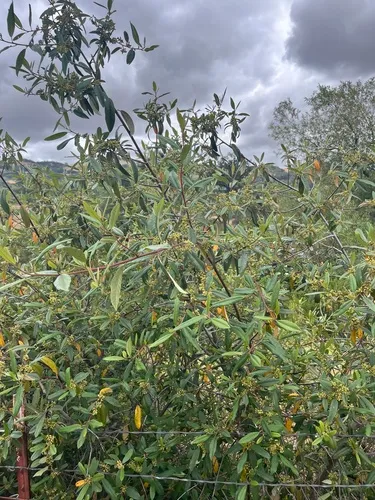
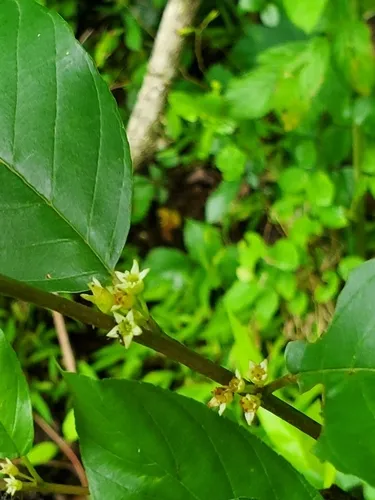
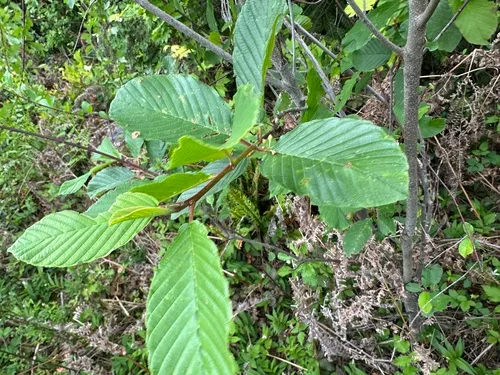
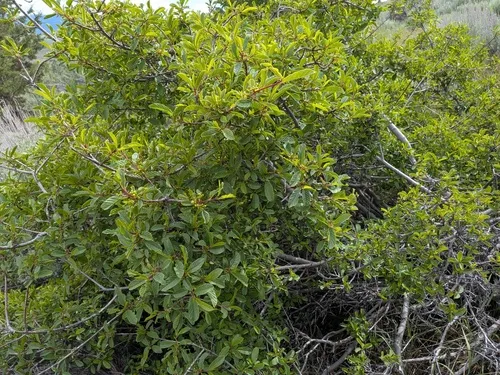
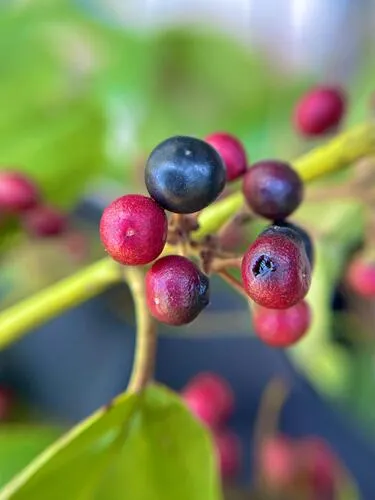
Pictured: Frangula betulifolia — the species. This subspecies isn’t separately illustrated.
Rhamnaceae family

Beechleaf Frangula (subsp. betulifolia) Frangula betulifolia subsp. betulifolia subspecies

Native

Beechleaf Frangula (subsp. betulifolia) is a perennial tree native to the lower 48 states. It grows to 7 ft and blooms May in full sun, with purple fruit.

More about this plant

Frangula betulifolia, the birchleaf buckthorn, is a shrub or small tree in the buckthorn family, Rhamnaceae. It is native in northern Mexico in the Sierra Madre Occidental cordillera, and mountainous, desert regions of the Southwestern United States of Arizona, Utah, New Mexico, and far west Texas; besides being found in Sonora, Chihuahua and Durango of the Occidental cordillera, a large species locale occurs to the east in Nuevo León. Wikipedia →

Growing & care

USDA PLANTS · TRY
Conditions
Sources · Conditions
USDA PLANTS — Sun
USDA — SoilPH — Soil pH
USDA PLANTS (DwCA, Zenodo 17903503) — Fertility Requirement / Soil Adaptation — Adapts to
USDA — Temp-Min °F — Hardiness
Sun
Full sun
Soil pH
6–8
Adapts to
Medium (loam)
Hardiness
USDA zone 6+
Size & form
Sources · Size & form
USDA PLANTS (DwCA, Zenodo 17903503) — Height, Mature — Height
USDA PLANTS (DwCA, Zenodo 17903503) — Growth Rate / Spread / Growth Form / Lifespan / Active Growth Period / Seed Period — Growth rate
USDA PLANTS — Lifespan
USDA PLANTS (DwCA, Zenodo 17903503) — Fruit/Seed Color / Fruit Persistence — Fruit
Lifespan: USDA’s lifespan scale for trees: short = under ~100 years · moderate = 100–250 · long = over 250. Balsam fir and other short-lived conifers are genuinely short for a tree, not short like an annual.
Height
7 ft
Growth rate
Moderate
Lifespan
Perennial · short-lived
Fruit
Purple
In the garden
Sources · In the garden
USDA PLANTS (DwCA, Zenodo 17903503) — Propagation Method / Commercial Availability — Propagate by
USDA PLANTS (DwCA, Zenodo 17903503) — Germination (cold stratification) — Seed starting
USDA PLANTS — Seed Period — Seeds ripen
USDA PLANTS (DwCA, Zenodo 17903503) — Foliage Texture / Browse Palatability / Resprout — Deer browsing · Resprouts if cut
Propagate by
Cuttings
Seed starting
No stratification needed
Seeds ripen
Summer – Autumn seed-collection / harvest window
Deer browsing
Medium moderately palatable
Resprouts if cut
No
Shrub layer — Sits in the shrub of a layered food forest or polyculture.Open guide →
derived roles
The garden year bloom → fruit → fall colour
J
F
M
A
M
J
J
A
S
O
N
D
Bloom
Fruit
Bloom (the flower's colour) Ripe fruit
Bloom · May — USDA PLANTS (DwCA, Zenodo 17903503) — BloomPeriod
Fruit · approximate season (USDA Seed Period), clamped to after bloom
When to sow · for your area

Sow timing keys off your local last- and first-frost dates.

Species characteristics from USDA PLANTS (public domain) + TRY (CC BY) — general guidance, not a guarantee for your exact site. Deer "browsing" is documented palatability, not a deer-proof claim.

Wildlife & pollinators

How pollinator value is scored →
❧ Caterpillar hosts ~11 caterpillar species

Frangula supports ~11 caterpillar species.

Native butterfly & moth caterpillars are the base of the terrestrial food web — most songbirds rear their young almost entirely on them. As a host for native Lepidoptera this is a moderate genus.

Keystone count (genus-level) from Warren II 2026 (CC0) · Tallamy host-use records. Named species (a documented Nearctic sample, not exhaustive) from NHM HOSTS (CC0).
Species thumbnails re-hosted from iNaturalist — Creative Commons, credited per image (hover for credit). Click any species to see it on iNaturalist. Not exhaustive; many taxa have no openly-licensed photo yet.
Sources for this entry (21) Open & cited
[01] Scientific name & family — USDA PLANTS (DwCA, Zenodo 17903503)
[02] Growth habit & duration — USDA PLANTS (DwCA, Zenodo 17903503)
[03] Native status & distribution — USDA PLANTS (DwCA, Zenodo 17903503)
[04] Common name — USDA PLANTS (via GBIF)
[16] Invasive / introduced status — USDA PLANTS (DwCA, Zenodo 17903503) — native status
[17] Description — Wikipedia (CC BY-SA)
[18] Ecological value — Warren II 2026 (CC0) · Tallamy host-use counts
[19] Caterpillar host count — Warren II 2026 (Dryad, CC0) · Tallamy host-use counts
[20] Caterpillar species — NHM HOSTS (CC0)
Spot an error or have a better photo? Every field links to its source, and the whole dataset is open.
Cite this page Open data, please attribute

PlantKey’s data is open under CC BY-SA 4.0 — free to reuse and adapt, with attribution and the same licence. Photos keep their own per-image licence + credit (see Sources above).

Citation

Loading…

BibTeX
Loading…