
Palmer's Seaheath Frankenia palmeri
Palmer's Seaheath is a perennial shrub native to the lower 48 states. It blooms Mar – May.
More about this plant
Frankenia palmeri is a species of flowering plant in the frankenia family, Frankeniaceae, known by the common name Palmer's seaheath, Palmer's frankenia, or yerba reuma. It is native to the coastline of northwestern Mexico, as well as San Diego County, California, in the United States. It is a plant of sand dunes, beaches, alkali flats, and salt marshes, where it thrives due to its adaptation to saline soils. This is a small, tangling shrub less than a meter tall with spreading stems lined with clusters of knobby, fleshy leaves. Toward the ends of branches flowers appear among the leaf clusters. Each flower has white petals 3 or 4 millimeters long, often washed with pink toward the throat and with pink anthers. The plant is becoming increasingly rare as its habitat on valuable coastal land is consumed for development. Wikipedia →
Growing & care
USDA PLANTS · TRY- Hardiness
- ≥ zone 11 derived from its U.S. range
- Lifespan
- Perennial
- Foliage
- Broadleaf
- Flower colour
- White AI AI image-analysis of community-science photos (~87% expert agreement) — not a botanical record
Wildlife & pollinators
How pollinator value is scored →❧ Caterpillar hosts Documented caterpillar host
Recorded feeding on Frankenia in North America, including:
Related plants
More Frankenia →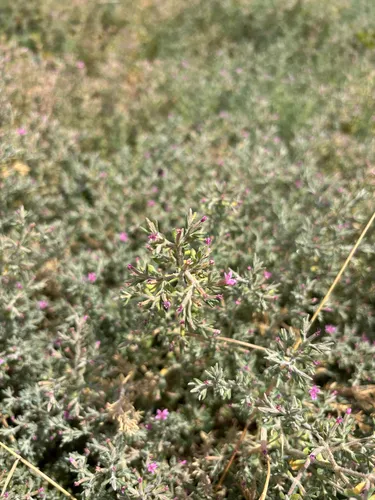
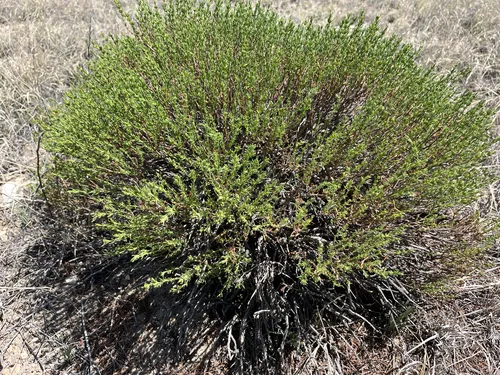
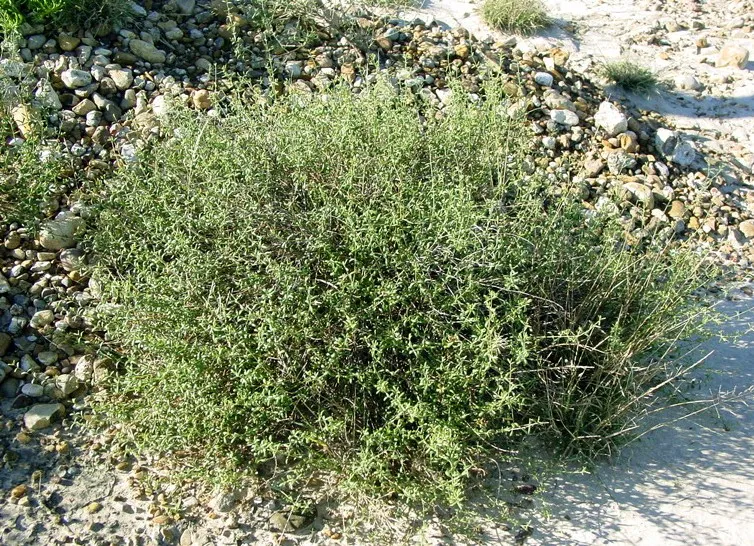
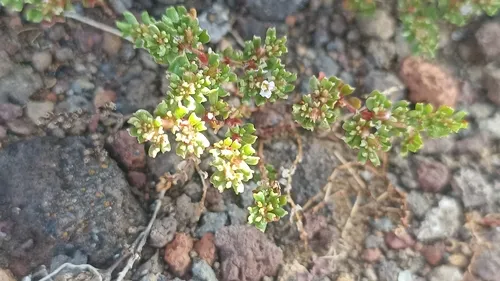
How we know this (1) Methods & honest limits
McKenzie et al. assigned each species a flower colour with a GPT-4V vision model over iNaturalist photos. We use the confident tier plus a separately-labelled lower-confidence top-up (mostly inconspicuous green/brown flowers), and render it as a small tint — never as an asserted fact, and kept out of the written synopsis.
Honest limits: AI image inference (~87% expert agreement on the confident tier); a decorative, confidence-tiered indicator, not a measured trait.
Sources for this entry (17) Open & cited
Cite this page Open data, please attribute
PlantKey’s data is open under CC BY-SA 4.0 — free to reuse and adapt, with attribution and the same licence. Photos keep their own per-image licence + credit (see Sources above).
Loading…
BibTeX
Loading…