
Italian Gladiolus Gladiolus italicus
Italian Gladiolus is an introduced perennial herb, found in the lower 48 states. It grows to 2.3 ft.
More about this plant
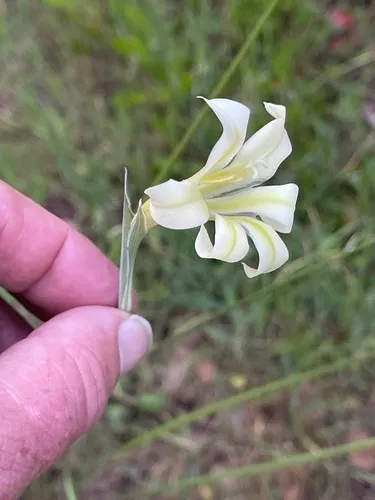
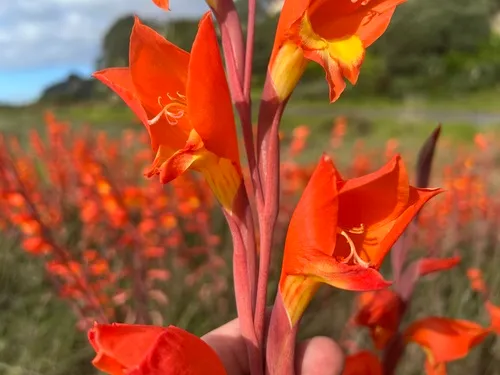
Gladiolus italicus is a species of gladiolus known by the common names Italian gladiolus, field gladiolus, and common sword-lily. It is native to much of Eurasia and North Africa, but it is well known on other continents where it is a common weed, particularly of cultivated fields and waste places. This perennial flower grows an erect stem approaching a meter in maximum height with a few long leaves around its base. Toward the top half of the generally unbranching stem is a spike inflorescence on which flowers appear at intervals. Each plant has up to 15 or 16 flowers. The flower is bright pink to magenta and several centimeters long with its stamens and style protruding from the throat. The fruit is a capsule about a centimeter long containing many seeds. Wikipedia →
Growing & care
USDA PLANTS · TRY- Hardiness
- ≥ zone 7 derived from its U.S. range
- Height
- 2.3 ft
- Lifespan
- Perennial
- Foliage
- Broadleaf
- Flower colour
- Pink AI AI image-analysis of community-science photos (~87% expert agreement) — not a botanical record
Wildlife & pollinators
How pollinator value is scored →❧ Caterpillar hosts ~17 caterpillar species
Gladiolus supports ~17 caterpillar species.
Native butterfly & moth caterpillars are the base of the terrestrial food web — most songbirds rear their young almost entirely on them. As a host for native Lepidoptera this is a moderate genus for introduced plants — native genera typically support far more.
Recorded feeding on Gladiolus in North America, including:


+ 8 more species → ↑ show fewer


✦ Bees 3 bee visitors
3 native & managed bee species are documented visiting Italian Gladiolus :


Wildlife & visitors 1 nectaring
Open records of who else uses Italian Gladiolus — a generalist food-web signal, kept separate from the keystone Ecological Value.
1 adult butterfly & moth species is recorded nectaring at its flowers:

Related plants
More Gladiolus →
How we know this (2) Methods & honest limits
A recorded categorical fact: each species is tagged C3 (standard), C4 (heat/water-efficient) or CAM (succulent, night-time CO₂ uptake) — or a facultative combination. We only show a trait card for the noteworthy C4/CAM cases; C3 is the unremarkable majority, kept in the data but not surfaced as a card.
McKenzie et al. assigned each species a flower colour with a GPT-4V vision model over iNaturalist photos. We use the confident tier plus a separately-labelled lower-confidence top-up (mostly inconspicuous green/brown flowers), and render it as a small tint — never as an asserted fact, and kept out of the written synopsis.
Honest limits: AI image inference (~87% expert agreement on the confident tier); a decorative, confidence-tiered indicator, not a measured trait.
Sources for this entry (22) Open & cited
Cite this page Open data, please attribute
PlantKey’s data is open under CC BY-SA 4.0 — free to reuse and adapt, with attribution and the same licence. Photos keep their own per-image licence + credit (see Sources above).
Loading…
BibTeX
Loading…