PlantKey Open ecological atlas
Planner
Home / Browse / Guillenia / California Mustard
Wikimedia Commons — CC, credited & licensed per image
Brassicaceae family

California Mustard Guillenia lasiophylla

Native
Early-season nectar — Flowers in a late-winter / early-spring window when few other plants in our catalog bloom — valuable early forage for pollinators (relative to our catalog's bloom coverage).

California Mustard is an annual wildflower native to the lower 48 states. It blooms Feb – May.

More about this plant

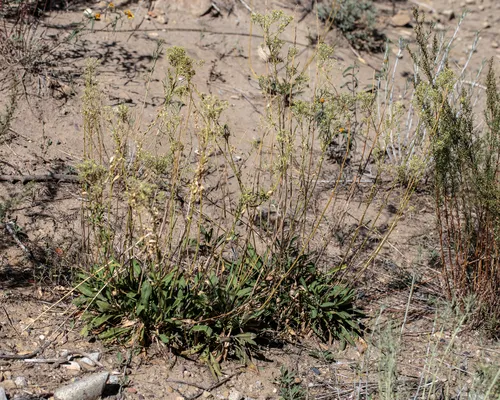
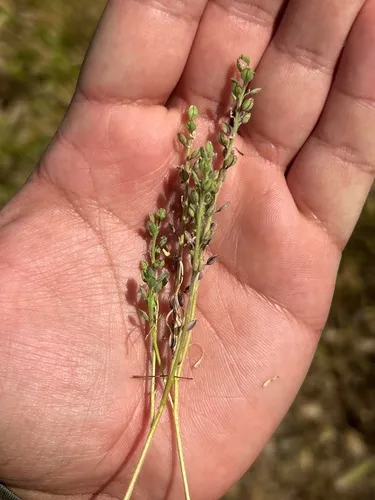
Streptanthus lasiophyllus, many synonyms including Guillenia lasiophylla, is a species of mustard plant known by the common names California mustard and slenderpod jewelflower. It is native to western North America from British Columbia to northern Mexico. It can be found in a variety of habitats such as desert flats, gravelly areas, limestone rocks, talus slopes, sandy banks, and grassy fields. This is a thin-stemmed erect annual herb with long lobed, toothed leaves surrounding the base of the plant and smaller leaves lining the stem. The top of the plant is occupied by an inflorescence of flowers, each with widely spaced oval-shaped white or yellowish petals half a centimeter long. The fruit is a flat, narrow silique up to 7 centimeters long which hangs downward from the stem. Flowers bloom March to June. Wikipedia →

Growing & care

USDA PLANTS · TRY
Conditions
Sources · Conditions
Cold hardiness (derived) — Hardiness
Hardiness
≥ zone 8 derived from its U.S. range
Size & form
Sources · Size & form
USDA PLANTS — Lifespan
Lifespan
Annual
In the garden
Herb layer — Sits in the herb of a layered food forest or polyculture.Open guide →
derived roles
The garden year bloom → fruit → fall colour
J
F
M
A
M
J
J
A
S
O
N
D
Bloom
Bloom (the flower's colour)
Bloom · Feb – May — 1,196 obs · Herbarium specimens — Park et al. 2023 (CC BY 4.0)
Species characteristics from USDA PLANTS (public domain) + TRY (CC BY) — general guidance, not a guarantee for your exact site. Deer "browsing" is documented palatability, not a deer-proof claim.

Wildlife & pollinators

How pollinator value is scored →
❧ Caterpillar hosts Documented caterpillar host
Named species (a documented Nearctic sample, not exhaustive) from NHM HOSTS (CC0). = recorded on this exact species.
Species thumbnails re-hosted from iNaturalist — Creative Commons, credited per image (hover for credit). Click any species to see it on iNaturalist. Not exhaustive; many taxa have no openly-licensed photo yet.
Sources for this entry (11) Open & cited
[01] Scientific name & family — USDA PLANTS (DwCA, Zenodo 17903503)
[02] Growth habit & duration — USDA PLANTS (DwCA, Zenodo 17903503)
[03] Native status & distribution — USDA PLANTS (DwCA, Zenodo 17903503)
[04] Common name — USDA PLANTS (via GBIF)
[05] Invasive / introduced status — USDA PLANTS (DwCA, Zenodo 17903503) — native status
[07] Description — Wikipedia (CC BY-SA)
[09] Cold hardiness (derived) — Derived from U.S. range × USDA PHZM zones
[11] Caterpillar species — NHM HOSTS (CC0)
Spot an error or have a better photo? Every field links to its source, and the whole dataset is open.
Cite this page Open data, please attribute

PlantKey’s data is open under CC BY-SA 4.0 — free to reuse and adapt, with attribution and the same licence. Photos keep their own per-image licence + credit (see Sources above).

Citation

Loading…

BibTeX
Loading…