
Common Sunflower Helianthus annuus
Common Sunflower is an annual wildflower native to the lower 48 states. It grows to 9 ft and blooms Jul in part shade – shade, with blue fruit. A host for pollen-specialist native bees.
More about this plant
The common sunflower is a large annual forb in the daisy family Asteraceae. The domesticated form of common sunflower is harvested for its edible seeds, which come in two types: oil and confectionary seeds. Oilseed sunflowers are widely grown globally and represent the fourth most used vegetable oil in the world. They also are used widely as bird food or as food for livestock. In contrast, confectionary sunflower seeds are often eaten as a snack food or in baking. There also are horticultural sunflower varieties that are used as plantings in domestic gardens for aesthetics. Wild plants are known for their multiple flower heads, whereas the domestic sunflower often possesses a single large flower head atop an unbranched stem. Wikipedia →
Growing & care
USDA PLANTS · TRY- Sun
- Part shade – shade
- Soil & moisture
- Medium moisture
- Soil pH
- 5.5–7.8
- Fertility need
- Low
- Adapts to
- Coarse (sandy), Medium (loam), Fine (clay)
- Hardiness
- USDA zone 13+
- Height
- 9 ft
- Spacing
- 2–3 ft apart from USDA planting density
- Spread
- None — clumping
- Growth rate
- Rapid
- Growth form
- Single crown
- Lifespan
- Annual
- Foliage
- Broadleaf · coarse texture
- Active growth
- Summer
- Fruit
- Blue persists into winter
- Flower colour
- Yellow AI AI image-analysis of community-science photos (~87% expert agreement) — not a botanical record
- Propagate by
- Seed
- Seed starting
- No stratification needed
- Seeds ripen
- Summer – Autumn seed-collection / harvest window
- In the trade
- Routinely available
- Deer browsing
- Medium moderately palatable
- Resprouts if cut
- No
Sow timing keys off your local last- and first-frost dates.
Wildlife & pollinators
How pollinator value is scored →❧ Caterpillar hosts ~75 caterpillar species
Helianthus supports ~75 caterpillar species.
Native butterfly & moth caterpillars are the base of the terrestrial food web — most songbirds rear their young almost entirely on them. As a host for native Lepidoptera this is a strong genus.
Recorded feeding on Helianthus in North America, including:


+ 8 more species → ↑ show fewer


✦ Bees specialist-bee host · 132 bee visitors
Specialist native bees depend on it.
Some native bees are pollen specialists (oligolectic) — they raise young only on pollen from particular plant genera. Helianthus is a recorded specialist-bee host, so losing it can mean losing the bee that relies on it.
132 native & managed bee species are documented visiting Common Sunflower — the 12 most-recorded:


Wildlife & visitors 44 birds · 3 mammals · 97 nectaring
Open records of who else uses Common Sunflower — a generalist food-web signal, kept separate from the keystone Ecological Value.
Recorded eaten by 44 birds and 3 mammals species (fruit, seed, browse) — the most-recorded:


+ 3 more species → ↑ show fewer


97 adult butterfly & moth species are recorded nectaring at its flowers — the most-recorded:


Across 28 U.S. vegetation-survey plots that recorded Common Sunflower, these catalog species turned up most often in the same plot — a real field co-occurrence signal, not a planting prescription.
Related plants
More Helianthus →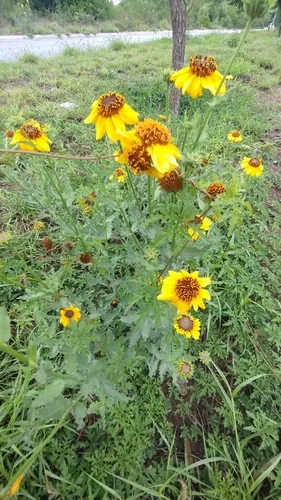
How we know this (6) Methods & honest limits
We read each species’ measured specific leaf area (leaf area per unit dry weight) from the Global Spectrum dataset and band it: thin & fast (high SLA), medium, or thick & tough (low SLA). The global median is about 10 mm²/mg.
Honest limits: A species-mean from pooled measurements — individual plants vary with light and site. A broad strategy signal, not a precise per-plant figure.
We place each species on Grime’s competitor–stress-tolerator–ruderal (C–S–R) triangle using the globally-calibrated “StrateFy” method: leaf size drives the competitor score, dense low-area leaves the stress-tolerator score, and thin high-area leaves the ruderal score. The result is a C/S/R percentage mix and one of 19 strategy classes; we show it in plain words and keep the percentages for the curious.
Honest limits: A species-mean strategy from pooled global leaf measurements — a broad ecological signal, not a precise per-plant or per-site value. Derived, never a measured fact.
A recorded categorical fact: each species is tagged C3 (standard), C4 (heat/water-efficient) or CAM (succulent, night-time CO₂ uptake) — or a facultative combination. We only show a trait card for the noteworthy C4/CAM cases; C3 is the unremarkable majority, kept in the data but not surfaced as a card.
We take the plant’s U.S. county range and look up each county’s long-term climate, then summarise: native rainfall = the median annual rainfall across its counties; heat tolerance = the warm end (90th percentile) of average temperature across its range (mirroring how our cold-hardiness floor uses an extreme). Counties + medians blunt the roadside/observer bias that makes point-level climate unreliable. Needs at least five placeable counties.
Honest limits: A realized, sampling-biased niche (where it has been recorded, not its physiological optimum), and county climate is coarse — large Western counties span deserts and mountains. Derived guide, never a measured fact.
A small, hand-checked crosswalk: each native edible is matched to its food in the USDA nutrient database (e.g. American persimmon → "Persimmons, native, raw", black walnut → "walnuts, black"), and we read that food’s per-100 g values. We only include matches that are unambiguous; a few genus-level commodities (e.g. mulberries) are marked as the closest food match. We do NOT auto-match by name (too error-prone) — so coverage is deliberately small.
Honest limits: Composition of the edible part as a food (often the cultivated/commodity form), matched by common food name — a guide, not a measurement of the exact wild plant. Never an identification or edibility guarantee.
McKenzie et al. assigned each species a flower colour with a GPT-4V vision model over iNaturalist photos. We use the confident tier plus a separately-labelled lower-confidence top-up (mostly inconspicuous green/brown flowers), and render it as a small tint — never as an asserted fact, and kept out of the written synopsis.
Honest limits: AI image inference (~87% expert agreement on the confident tier); a decorative, confidence-tiered indicator, not a measured trait.
Sources for this entry (42) Open & cited
Cite this page Open data, please attribute
PlantKey’s data is open under CC BY-SA 4.0 — free to reuse and adapt, with attribution and the same licence. Photos keep their own per-image licence + credit (see Sources above).
Loading…
BibTeX
Loading…