
Ballhead Ipomopsis (subsp. frutescens) Ipomopsis congesta subsp. frutescens subspecies
Ballhead Ipomopsis (subsp. frutescens) is a perennial shrub native to the lower 48 states.
More about this plant
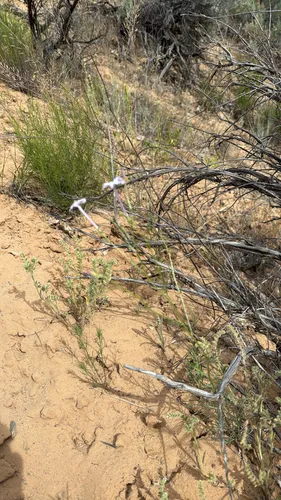
Ipomopsis congesta is a species of flowering plant in the phlox family, commonly called ballhead skyrocket. It is native to much of western North America, where it grows in many habitats from alpine peaks to low-elevation scrub. It is a perennial herb which varies in appearance, especially across subspecies and climates. It may take the form of a squat patch with stems under 10 centimeters in height or a more erect form up to 30 centimeters tall. The stems are often hairy to woolly. The thick leaves are usually fork-shaped with a number of clawlike lobes and 1 to 4 centimeters long. The flowers appear in a rounded, dense cluster atop the stem. Each flower is bell-shaped to funnel-shaped and white with a pale yellow throat and protruding yellow or white stamens. There are several subspecies, many of which were formerly considered species of Gilia. Wikipedia →
Growing & care
USDA PLANTS · TRY- Hardiness
- ≥ zone 7 derived from its U.S. range
- Lifespan
- Perennial
Wildlife & pollinators
How pollinator value is scored →❧ Caterpillar hosts ~1 caterpillar species
Ipomopsis supports ~1 caterpillar species.
Native butterfly & moth caterpillars are the base of the terrestrial food web — most songbirds rear their young almost entirely on them. As a host for native Lepidoptera this is a modest genus.
Recorded feeding on Ipomopsis in North America, including:

Related plants
More Ipomopsis →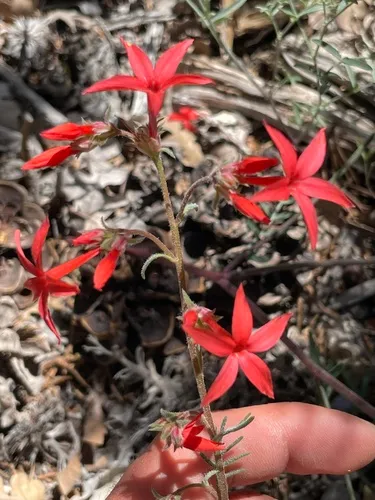
Sources for this entry (12) Open & cited
Cite this page Open data, please attribute
PlantKey’s data is open under CC BY-SA 4.0 — free to reuse and adapt, with attribution and the same licence. Photos keep their own per-image licence + credit (see Sources above).
Loading…
BibTeX
Loading…