
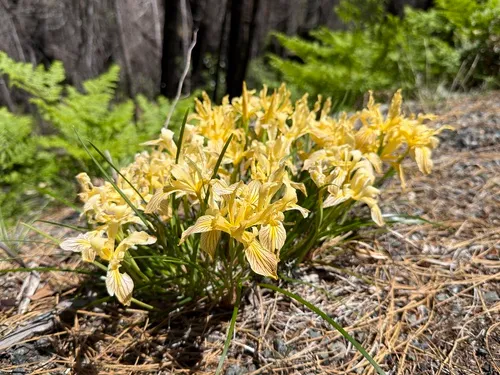
Seashore Iris (subsp. ochroleuca) Iris spuria subsp. ochroleuca subspecies
Seashore Iris (subsp. ochroleuca) is an introduced perennial herb, found in the lower 48 states.
More about this plant
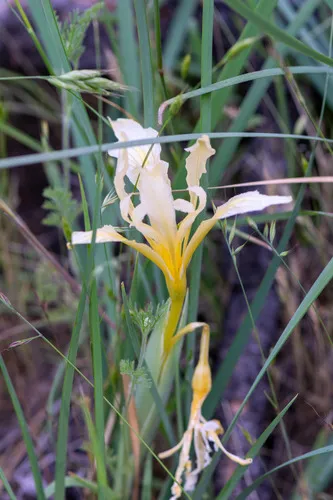
Iris spuria, or blue flag, is a species of the genus Iris, part of the subgenus Limniris and the series Spuriae. It is a rhizomatous perennial plant, from Europe, Asia and Africa. It has purple or lilac flowers, and slender, elongated leaves. It is widely cultivated as an ornamental plant in temperate regions and hybridized for use in the garden. It has several subspecies; Iris spuria subsp. carthaliniae B.Mathew, Iris spuria subsp. demetrii B.Mathew, Iris spuria subsp. maritima (Dykes) P.Fourn. and Iris spuria subsp. musulmanica (Fomin) Takht. It used to have 3 other subspecies, which have now been re-classified as separate species; Iris spuria subsp. halophila, Iris spuria ssp. sogdiana and Iris spuria subsp. notha . It has many common names including 'blue iris', 'spurious iris' and 'bastard iris'. Wikipedia →
Growing & care
USDA PLANTS · TRY- Hardiness
- ≥ zone 7 derived from its U.S. range
- Lifespan
- Perennial
Wildlife & pollinators
How pollinator value is scored →❧ Caterpillar hosts ~16 caterpillar species
Iris supports ~16 caterpillar species.
Native butterfly & moth caterpillars are the base of the terrestrial food web — most songbirds rear their young almost entirely on them. As a host for native Lepidoptera this is a moderate genus.
Recorded feeding on Iris in North America, including:


+ 8 more species → ↑ show fewer


Related plants
More Iris →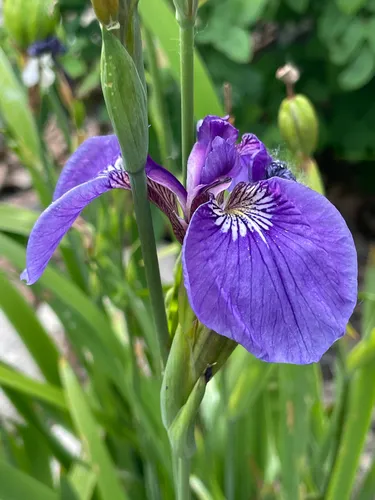
Sources for this entry (12) Open & cited
Cite this page Open data, please attribute
PlantKey’s data is open under CC BY-SA 4.0 — free to reuse and adapt, with attribution and the same licence. Photos keep their own per-image licence + credit (see Sources above).
Loading…
BibTeX
Loading…