
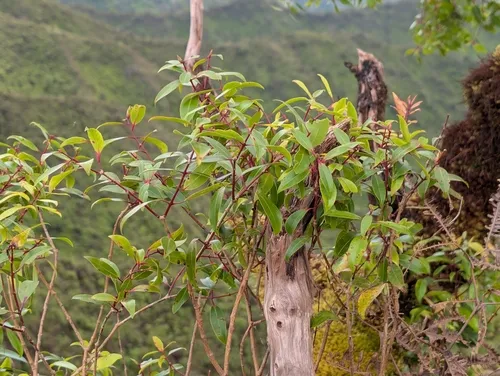
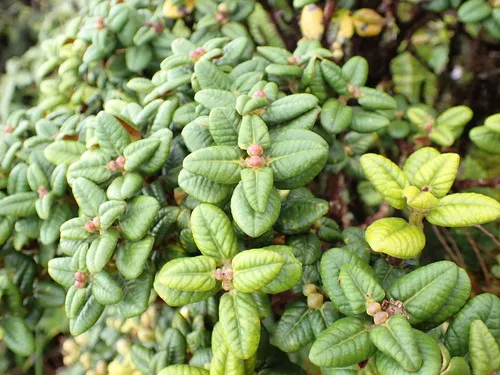
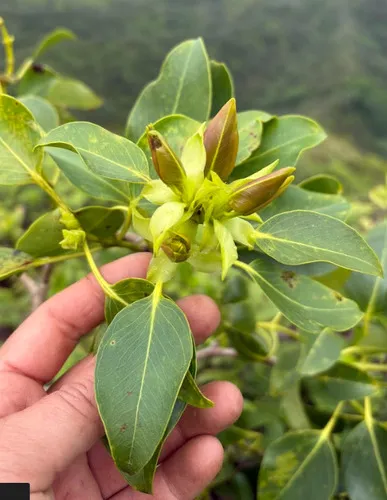
'ohi'a Lehua Metrosideros polymorpha
'ohi'a Lehua is a perennial tree native to Hawaii. It grows to 65 ft and blooms May in part shade – shade, with brown fruit.
Growing & care
USDA PLANTS · TRY- Sun
- Part shade – shade
- Soil & moisture
- Medium moisture
- Soil pH
- 4.3–5.7
- Fertility need
- Medium
- Adapts to
- Coarse (sandy), Medium (loam)
- Hardiness
- USDA zone 10+
- Height
- 65 ft
- Mature width
- ~ 39 ft wide DERIVED derived estimate — open-grown crown allometry (height × growth-form ratio); not a measurement
- Spacing
- 8–12 ft apart from USDA planting density
- Spread
- Moderate
- Growth rate
- Slow
- Growth form
- Single stem
- Lifespan
- Perennial · moderate
- Foliage
- Evergreen broadleaf · coarse texture
- Active growth
- Spring & summer
- Fruit
- Brown
- Propagate by
- Seed, Cuttings, Bare root, Container
- Seed starting
- No stratification needed
- Seeds ripen
- Autumn – Winter seed-collection / harvest window
- In the trade
- Routinely available
- Resprouts if cut
- Yes regrows after top-kill
Sow timing keys off your local last- and first-frost dates.
Wildlife & pollinators
How pollinator value is scored →✦ Bees 6 bee visitors
6 native & managed bee species are documented visiting 'ohi'a Lehua :


Wildlife & visitors 6 birds
Open records of who else uses 'ohi'a Lehua — a generalist food-web signal, kept separate from the keystone Ecological Value.
Recorded eaten by 6 birds species (fruit, seed, browse):


Related plants
More Metrosideros →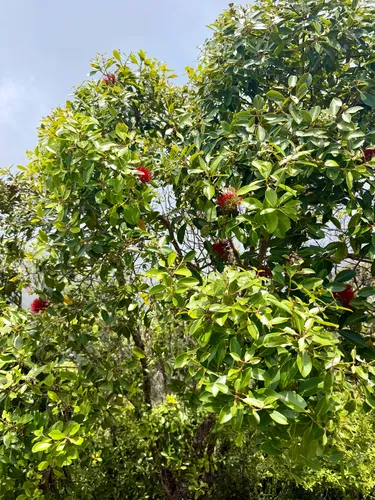
How we know this (3) Methods & honest limits
We read each species’ measured specific leaf area (leaf area per unit dry weight) from the Global Spectrum dataset and band it: thin & fast (high SLA), medium, or thick & tough (low SLA). The global median is about 10 mm²/mg.
Honest limits: A species-mean from pooled measurements — individual plants vary with light and site. A broad strategy signal, not a precise per-plant figure.
A recorded categorical fact: each species is tagged C3 (standard), C4 (heat/water-efficient) or CAM (succulent, night-time CO₂ uptake) — or a facultative combination. We only show a trait card for the noteworthy C4/CAM cases; C3 is the unremarkable majority, kept in the data but not surfaced as a card.
For woody plants that have a height but no measured crown, we estimate width = height × a crown-to-height ratio fit for that plant’s form (conifers narrower than broadleaf trees, shrubs widest), calibrated on our measured open-grown crowns and capped at the largest one ever measured. A measured crown always wins; herbaceous plants get nothing (no anchor).
Honest limits: A coarse class-median estimate for garden-scale spacing, not a measurement; woody single/multi-stem forms only.
Sources for this entry (33) Open & cited
Cite this page Open data, please attribute
PlantKey’s data is open under CC BY-SA 4.0 — free to reuse and adapt, with attribution and the same licence. Photos keep their own per-image licence + credit (see Sources above).
Loading…
BibTeX
Loading…