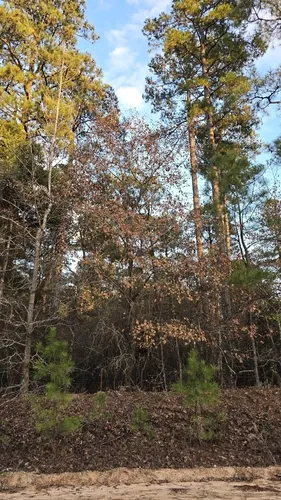
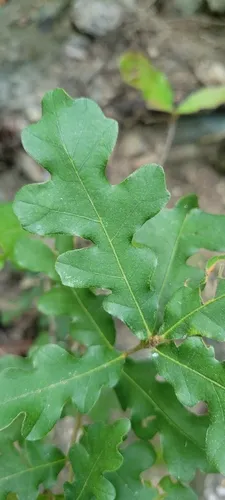
PlantKey Open ecological atlas
Planner
Home / Browse / Quercus / Holly Oak
Wikimedia Commons — CC, credited & licensed per image
Fagaceae family

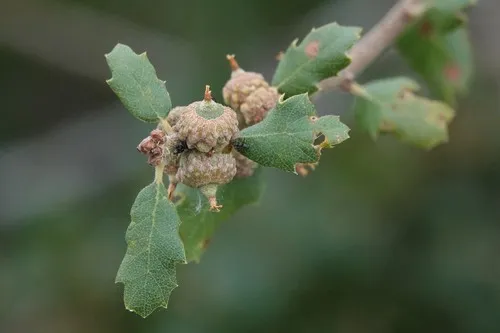
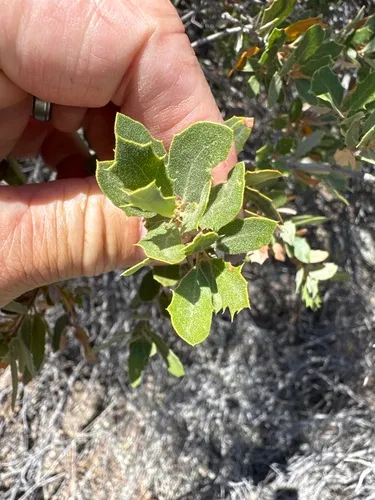
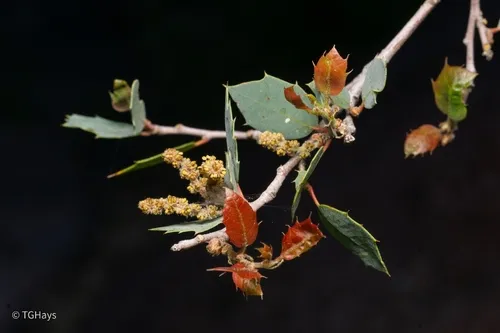
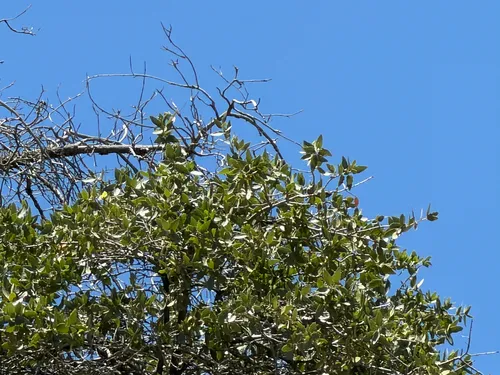
Holly Oak Quercus ilex

Drought-tough — Rated High for drought tolerance, corroborated by deep roots — a water-wise pick once it's established.
Also known as: Holm Oak

Holly Oak is an introduced perennial tree, found in the lower 48 states. It grows to 31 ft and blooms Apr – Jun.

⚠ Invasive here — plant a native instead USDA + GBIF

Holly Oak is flagged invasive in the U.S. These natives fill a similar niche — same growth habit, bloom season, height, and region — so you keep the look and feed local wildlife instead of spreading a problem.
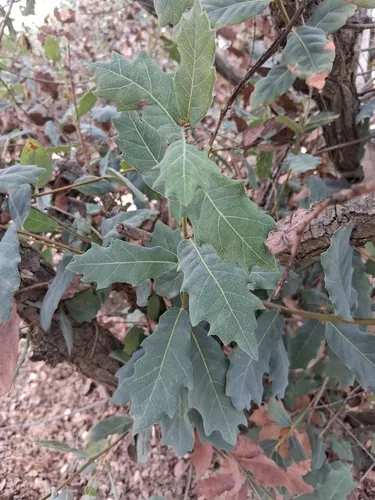
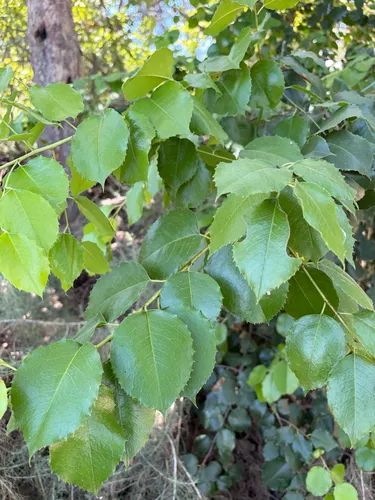
Matched on growth habit · bloom months · mature height · shared U.S. range (USDA + GBIF) — a starting point, not a prescription.

Growing & care

USDA PLANTS · TRY
Conditions
Sources · Conditions
Cold hardiness (derived) — Hardiness
Niinemets & Valladares 2006 (CC0) — Drought tolerance · Shade tolerance · Wet-soil tolerance
Hardiness
≥ zone 11 derived from its U.S. range
Drought tolerance
High
Shade tolerance
Moderate
Wet-soil tolerance
Low waterlogging
Size & form
Sources · Size & form
TRY Plant Trait Database (CC BY 4.0) — Height · Foliage
USDA Urban Tree DB (PD, open-grown) · Tallo — Jucker et al. 2025 (CC BY, wild) — Mature width
USDA PLANTS — Lifespan
Height
31 ft
Mature width
≈ 55 ft wide open-grown · ~40 ft in the wild
Lifespan
Perennial
Foliage
Evergreen broadleaf
In the garden
Sub-canopy / understory layer — Sits in the understory of a layered food forest or polyculture. Its deep roots also work the lower soil profile.Open guide →
derived roles
The garden year bloom → fruit → fall colour
J
F
M
A
M
J
J
A
S
O
N
D
Bloom
Bloom (the flower's colour)
Bloom · Apr – Jun — 25 obs · Herbarium specimens — Park et al. 2023 (CC BY 4.0)
Species characteristics from USDA PLANTS (public domain) + TRY (CC BY) — general guidance, not a guarantee for your exact site. Deer "browsing" is documented palatability, not a deer-proof claim.

Wildlife & pollinators

How pollinator value is scored →
❧ Caterpillar hosts ~532 caterpillar species · keystone genus

Quercus supports ~532 caterpillar species.

Native butterfly & moth caterpillars are the base of the terrestrial food web — most songbirds rear their young almost entirely on them. As a host for native Lepidoptera this is a powerhouse genus.

Keystone count (genus-level) from Warren II 2026 (CC0) · Tallamy host-use records. Named species (a documented Nearctic sample, not exhaustive) from NHM HOSTS (CC0). = recorded on this exact species.
✦ Bees 6 bee visitors
Visitor records (observations, not exhaustive) from Noori et al. 2026 (CC BY 4.0) · GloBI →
Wildlife & visitors 2 birds · 8 mammals · 3 nectaring

Open records of who else uses Holly Oak — a generalist food-web signal, kept separate from the keystone Ecological Value.

3 adult butterfly & moth species are recorded nectaring at its flowers:

Interaction records (observations, not exhaustive) from GloBI → (CC0). Counts are distinct species; names are the most-recorded. Common names from Wikidata (CC0).
Species thumbnails re-hosted from iNaturalist — Creative Commons, credited per image (hover for credit). Click any species to see it on iNaturalist. Not exhaustive; many taxa have no openly-licensed photo yet.
How we know this (3) Methods & honest limits
Leaf build Direct fact

We read each species’ measured specific leaf area (leaf area per unit dry weight) from the Global Spectrum dataset and band it: thin & fast (high SLA), medium, or thick & tough (low SLA). The global median is about 10 mm²/mg.

Honest limits: A species-mean from pooled measurements — individual plants vary with light and site. A broad strategy signal, not a precise per-plant figure.

Díaz, S. et al. (2022) The global spectrum of plant form and function: enhanced species-level trait dataset. Scientific Data 9:755.
Photosynthesis Direct fact

A recorded categorical fact: each species is tagged C3 (standard), C4 (heat/water-efficient) or CAM (succulent, night-time CO₂ uptake) — or a facultative combination. We only show a trait card for the noteworthy C4/CAM cases; C3 is the unremarkable majority, kept in the data but not surfaced as a card.

Kattge, J. et al. TRY plant trait database — Categorical Traits Dataset (2012).
Climate niche (heat tolerance & native rainfall) Derived

We take the plant’s U.S. county range and look up each county’s long-term climate, then summarise: native rainfall = the median annual rainfall across its counties; heat tolerance = the warm end (90th percentile) of average temperature across its range (mirroring how our cold-hardiness floor uses an extreme). Counties + medians blunt the roadside/observer bias that makes point-level climate unreliable. Needs at least five placeable counties.

Honest limits: A realized, sampling-biased niche (where it has been recorded, not its physiological optimum), and county climate is coarse — large Western counties span deserts and mountains. Derived guide, never a measured fact.

Realized-niche / climate-envelope approach (Pearson & Dawson 2003; Soberón 2007). Climate: NOAA NCEI nClimDiv county normals (1991–2020).
Derived values are computed from open data by a published method — labelled, cited, and never shown as a direct observation. Full methodology →
Sources for this entry (27) Open & cited
[01] Scientific name & family — USDA PLANTS (DwCA, Zenodo 17903503)
[02] Growth habit & duration — USDA PLANTS (DwCA, Zenodo 17903503)
[03] Native status & distribution — USDA PLANTS (DwCA, Zenodo 17903503)
[04] Common name — USDA PLANTS (via GBIF)
[05] Invasive / introduced status — US-RIIS v2.0 (USGS)
[07] Ecological value — Warren II 2026 (CC0) · Tallamy host-use counts
[11] Functional traits — TRY Plant Trait Database (CC BY 4.0)
[12] Photosynthetic pathway — TRY Plant Trait Database (CC BY 4.0)
[13] Climate niche — Derived — realized climate niche from U.S. county occurrences (GBIF) × NOAA NCEI county climate normals 1991–2020 (public domain)
[14] Cold hardiness (derived) — Derived from U.S. range × USDA PHZM zones
[15] Wildlife & visitors — GloBI — Global Biotic Interactions (CC0)
[17] Rooting depth — Fan et al. 2017 (Dryad, CC0)
[21] Other common names — Wikidata (CC0)
[22] Stress tolerance — Niinemets & Valladares 2006 (CC0)
[24] Flower-visitor value (derived) — Noori et al. 2026 (CC BY 4.0) · GloBI
[25] Caterpillar host count — Warren II 2026 (Dryad, CC0) · Tallamy host-use counts
[26] Caterpillar species — NHM HOSTS (CC0)
[27] County range — GBIF Open Data — open-licensed occurrences (CC0/CC-BY) → county
Spot an error or have a better photo? Every field links to its source, and the whole dataset is open.
Cite this page Open data, please attribute

PlantKey’s data is open under CC BY-SA 4.0 — free to reuse and adapt, with attribution and the same licence. Photos keep their own per-image licence + credit (see Sources above).

Citation

Loading…

BibTeX
Loading…