PlantKey Open ecological atlas
Planner
Home / Browse / Salvia / Wild Clary
iNaturalist — CC, credited & licensed per image
Lamiaceae family

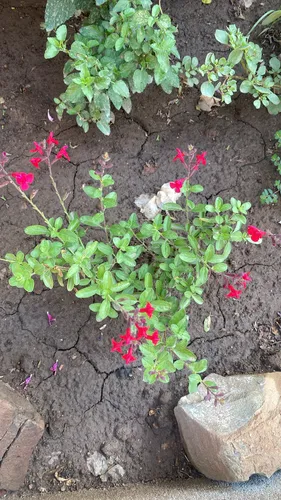
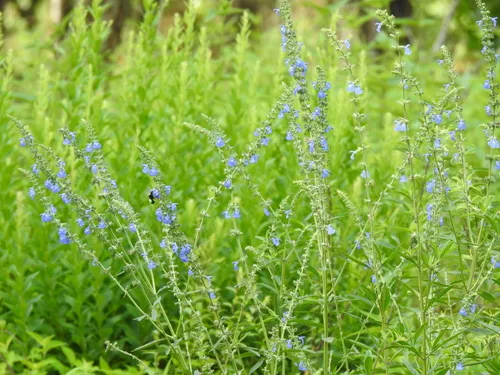
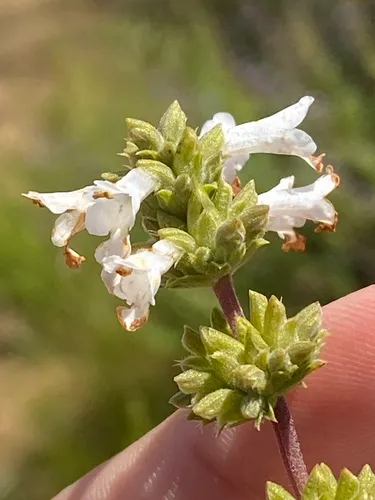
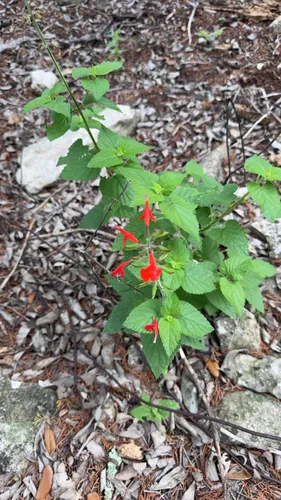
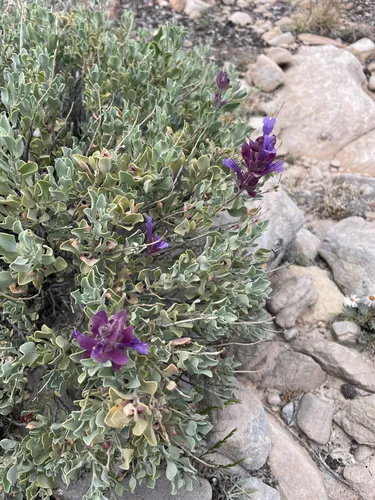
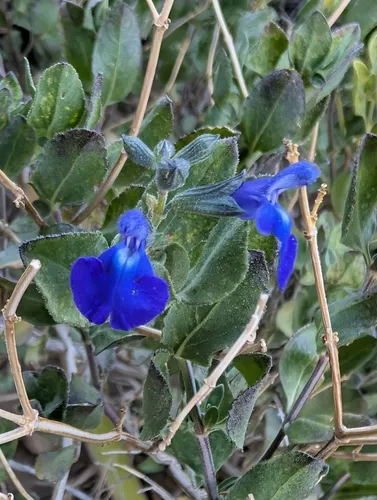
Wild Clary Salvia verbenaca

Also known as: verbena sage · vervain sage · wild sage

Wild Clary is an introduced perennial herb, found in the lower 48 states. It grows to 1.5 ft.

Growing & care

USDA PLANTS · TRY
Conditions
Sources · Conditions
Cold hardiness (derived) — Hardiness
Hardiness
≥ zone 8 derived from its U.S. range
Size & form
Sources · Size & form
TRY Plant Trait Database (CC BY 4.0) — Height · Foliage
USDA PLANTS — Lifespan
Height
1.5 ft
Lifespan
Perennial
Foliage
Broadleaf
In the garden
Herb layer — Sits in the herb of a layered food forest or polyculture.Open guide →
derived roles
Species characteristics from USDA PLANTS (public domain) + TRY (CC BY) — general guidance, not a guarantee for your exact site. Deer "browsing" is documented palatability, not a deer-proof claim.

Wildlife & pollinators

How pollinator value is scored →
❧ Caterpillar hosts ~6 caterpillar species

Salvia supports ~6 caterpillar species.

Native butterfly & moth caterpillars are the base of the terrestrial food web — most songbirds rear their young almost entirely on them. As a host for native Lepidoptera this is a modest genus.

Keystone count (genus-level) from Warren II 2026 (CC0) · Tallamy host-use records. Named species (a documented Nearctic sample, not exhaustive) from NHM HOSTS (CC0).
✦ Bees specialist-bee host · 28 bee visitors

Specialist native bees depend on it.

Some native bees are pollen specialists (oligolectic) — they raise young only on pollen from particular plant genera. Salvia is a recorded specialist-bee host, so losing it can mean losing the bee that relies on it.

Specialist hosts from Smith et al. 2024. Visitor records (observations, not exhaustive) from Noori et al. 2026 (CC BY 4.0) · GloBI →
Wildlife & visitors 1 bird · 9 nectaring

Open records of who else uses Wild Clary — a generalist food-web signal, kept separate from the keystone Ecological Value.

Recorded eaten by 1 bird species (fruit, seed, browse):

Interaction records (observations, not exhaustive) from GloBI → (CC0). Counts are distinct species; names are the most-recorded. Common names from Wikidata (CC0).
Species thumbnails re-hosted from iNaturalist — Creative Commons, credited per image (hover for credit). Click any species to see it on iNaturalist. Not exhaustive; many taxa have no openly-licensed photo yet.
How we know this (2) Methods & honest limits
Leaf build Direct fact

We read each species’ measured specific leaf area (leaf area per unit dry weight) from the Global Spectrum dataset and band it: thin & fast (high SLA), medium, or thick & tough (low SLA). The global median is about 10 mm²/mg.

Honest limits: A species-mean from pooled measurements — individual plants vary with light and site. A broad strategy signal, not a precise per-plant figure.

Díaz, S. et al. (2022) The global spectrum of plant form and function: enhanced species-level trait dataset. Scientific Data 9:755.
Photosynthesis Direct fact

A recorded categorical fact: each species is tagged C3 (standard), C4 (heat/water-efficient) or CAM (succulent, night-time CO₂ uptake) — or a facultative combination. We only show a trait card for the noteworthy C4/CAM cases; C3 is the unremarkable majority, kept in the data but not surfaced as a card.

Kattge, J. et al. TRY plant trait database — Categorical Traits Dataset (2012).
Derived values are computed from open data by a published method — labelled, cited, and never shown as a direct observation. Full methodology →
Sources for this entry (22) Open & cited
[01] Scientific name & family — USDA PLANTS (DwCA, Zenodo 17903503)
[02] Growth habit & duration — USDA PLANTS (DwCA, Zenodo 17903503)
[03] Native status & distribution — USDA PLANTS (DwCA, Zenodo 17903503)
[04] Common name — USDA PLANTS (via GBIF)
[05] Invasive / introduced status — US-RIIS v2.0 (USGS)
[07] Ecological value — Warren II 2026 (CC0) · Tallamy host-use counts · Smith et al. 2024 (CC BY)
[10] Functional traits — TRY Plant Trait Database (CC BY 4.0)
[11] Photosynthetic pathway — TRY Plant Trait Database (CC BY 4.0)
[12] Cold hardiness (derived) — Derived from U.S. range × USDA PHZM zones
[13] Wildlife & visitors — GloBI — Global Biotic Interactions (CC0)
[17] Other common names — Wikidata (CC0)
[19] Flower-visitor value (derived) — Noori et al. 2026 (CC BY 4.0) · GloBI
[20] Caterpillar host count — Warren II 2026 (Dryad, CC0) · Tallamy host-use counts
[21] Caterpillar species — NHM HOSTS (CC0)
[22] County range — GBIF Open Data — open-licensed occurrences (CC0/CC-BY) → county
Spot an error or have a better photo? Every field links to its source, and the whole dataset is open.
Cite this page Open data, please attribute

PlantKey’s data is open under CC BY-SA 4.0 — free to reuse and adapt, with attribution and the same licence. Photos keep their own per-image licence + credit (see Sources above).

Citation

Loading…

BibTeX
Loading…